We have rattled on about how social media can help in recruitment and in every business to communicate quickly with their customers, but the one that we seem to forget about is video. Video, as it seems has adapted with the times, with being an integral part in social content sharing and is a key asset in delivering quick detailed information. How can video help in recruitment?

In short videos can be use as job advertising and in the interview process.

Studio in your hands

As video technology develops, it’s becoming extremely easy to communicate with. The time for cumbersome and expensive video equipment and complicated editing software are behind us. Anyone with a decent phone can record and upload the content to video sharing websites in a matter of minutes. Youtube can be used to give applicants all the information required in just a few minutes and that message can be sent to thousands upon thousands of possible candidates in seconds. Applications like FaceTime and Skype make it remarkably easy for candidates and employers to meet “face-to-face” without geographical locations being a factor. Scheduling a time for an interview is severely cut as a time can be worked around pre-existing arrangements. Video interviewing allows for a better sense of who the candidate is instead of making judgement on their CV, the applicant can give you all the information directly to you that they could not fit on paper.

With today’s technological advancements, all this can be done from your phone.

Showcase your good side

For candidates, video gives the capability of candidates recording an introductory video, eliminating the need for a live video interview and even the traditional first stages of an interview. Attaching the recorded video to the rest of their digital application would be then sent to hiring managers and decision makers simultaneously.

For clients, having the ability to showcase the company, the culture and organisational structure can make applying to the company more appealing and engaging for the candidate. Besides providing a “fly on the wall” view of the company you are also giving the impression that your company is at the forefront of utilising technology. Video’s can also be used to attract talented millennials.

Benefits are limitless

Interview may be conducted using a representative of who the candidate would be working for due to busy schedules. With video the person who the candidate would work directly under could take part in the interview process. Additional benefits are a group of hiring managers can easily collaborate to make hiring decisions much quicker than traditional means.

Employers can also quickly and easily extract candidates who skills do not match up to their requirements.

Screening candidates for any role becomes less time intensive and considerably reduces cost with utilising video, whether is a vacancy for an entry level position or senior executive level candidates. They are extremely busy and travel time and costs are immediately eliminated. If employers are hiring internationally the cost and travel time is cut exponentially.

Other skills can be assessed with video; some role may consist of public speaking or presentation skills. These skills are showcased from the outset of a video interview and the interview can see how well a candidate reactive being in front of a camera.

Although video should be implemented. There is still a need for face to face meetings. The traditional method shows how well a candidate can interact with staff that they will be working with. However, a guaranteed face to face interview can be scheduled further down the recruitment line when the candidates have been shortlisted.

Having recruited IT & Business Project Managers for the last 12 years I am constantly reminded of the benefits of talking face to face instead of over the phone, email or Skype.

While meeting with these project managers does provide a significant insight into their approach to project delivery, I am not referring to that on this occasion. Instead, I am referring to the value that project managers achieve from getting out from behind their desk to actually sit with and meet those awkward team members or challenging suppliers. Of course, Skype and conference calls have their place in today’s businesses but when I look back over the years or even recent weeks to some of the strongest project managers I’ve met with, all of them have spoken of the value of meeting face to face. I called some of them to discuss this blog and to ask why they make the time for meeting face to face even when it can be more expensive in terms of time, cost or just the inconvenience involved.  The reasons below were stated by all of the project managers I spoke with recently as to why they make time for face to face meetings when necessary:

  • Helps to ensure engagement – Who knows what people are doing on conference calls when not speaking (you might not want to!!)
  • Drives participation – When in the same room it encourages people to participate. You can’t turn your back which is what happens throughout conference calls
  • More efficient – face to face there is greater pressure to get to the point
  • Clarifies meaning – It can be much harder to raise your hand to ask for clarification on a matter than it is in person
  • Body Language – We tend to forget that body language plays a major part in communication. This is lost on a phone call or email

How many of you value a face to face meeting and when was the last time you ran one? If the answer is not recently then I would challenge you to meet your toughest stakeholders and project team member to improve the relationship.

“Senator, we place ads,” will probably be one of those phrases that will forever remain a part of our memory of 2018. Whatever your opinion on the Facebook discussion may be, none of us can deny that the social network has utilised the latest in Artificial Intelligence to aid the advertising efforts of its paying clients. Most of us are Senator Cornyn when it comes to understanding the differences between AI, ML and DL. He knew what Facebook was but didn’t quite understand how it works.

We talk about the social, moral and political issues surrounding Artificial Intelligence, Machine Learning and Deep Learning, but often it’s not very clear what these terms mean, how they differ from one another and what might be everyday examples of each. These terms are often used interchangeably despite meaning somewhat different things. We can recognise AI and ML when we see it, for example in predictive texts that learn from our messages and add words to the phone dictionary. But if you were asked to define each concept and explain how it works and how it differs from the others, we would hazard a guess that such a task would be somewhat more complicated.

In light of this, we have put together this post to explain the difference between Artificial Intelligence, Machine Learning and Deep Learning, so that when it comes to these three concepts, none of us risk embarrassing ourselves similarly to the senator who didn’t understand how Facebook makes money.

Before we delve into explaining the differences, it is important to explain the most important building block of these technological advances – algorithms.

Computers know what to do with the code they are given. But before writing code, you need an algorithm.

At its most basic level, an algorithm is a sequential list of rules to follow that lead to solving a problem. Sequencing is crucial. Cooking is a helpful example of the importance of order in an algorithm. When you ask someone how to make steak, they don’t tend to give you the steps in random order or in a different order each time.

“Well, you put meat on a plate, then the plate on a hot stove, then place a pan on top of it and season the top of the pan.”

a man telling a woman the wrong order in which to make food

The order of things matters and that is exactly how an algorithm functions. The code is a recipe to be executed by a computer exactly in the order it is laid out.


Artificial Intelligence

Artificial Intelligence sounds like someone who took a 10 question “totally legit” test on BuzzFeed and got an IQ score of 250. Fake intelligence. You can’t trust it, no one has verified it.

But that’s not it. So why is it called artificial intelligence? What’s artificial about it?

There is much dispute over this, with some claiming that artificial should stand for ‘false’ because it’s not human, and others saying ‘artificial’ only because it is created by humans and didn’t originate from natural causes. The scientific community hasn’t firmly decided one or the other, and neither will we.

So what is AI then?

AI is the best umbrella term for explaining advanced computer intelligence.

It summarises the efforts to make computers think the way we think, to be able to simulate human cognitive thinking and decision-making, leading to human-like actions, and ultimately to be better and faster at problem-solving than we are.

Artificial intelligence (AI) makes it possible for machines to use experience for learning, adjust to new inputs and perform human-like tasks.

Artificial intelligence is generally divided into two types – narrow (or weak) AI and general AI, also known as AGI or strong AI. More recently a third type has been introduced – conscious AI.


  1. Narrow AI

Narrow AI is designed to perform one task at a time and to continue improving its execution. The goal is to find an automated solution to a problem or inconvenience or to simply improve something that already works, but can work better.

Currently, most of Artificial Intelligence is Narrow AI. Narrow AI tends to be software that is automating an activity typically performed by humans, and in the majority of the cases it exceeds or aims to exceed, human ability in efficiency and endurance.

Examples of narrow AI:

  • Self-driving cars that learn how to drive like Google and Uber cars, which as of now exist
  • Recognizing your face at your nearby bank office to help you with a more personal experience
  • We can ask our smartphones about the weather and expect accurate predictions.
  1. General AI

Some call it ‘The True AI’ because it is the next step towards more comprehensive machine intelligence. Rather than focusing on a single task, the goal is to teach the machine to comprehend and reason on a wide level just like a human would.

The goal is the machine’s ability to think generally, to be able to make decisions based on learning rather than previous training. It would have the ability to take training into consideration but then make a judgement on whether there is another, more appropriate course of action to be taken. Independent learning from experience, which is the way humans learn and reason, is the goal.

We are talking about creating an intelligence that is equivalent to that of a human being. That is a lofty task and one that we are still so far from accomplishing, but the geniuses of our time are hard at work to get closer and closer to this goal.

Over time, four tests of AGI have emerged as the primary definitions of the concept and the marker for judging whether something is generally intelligent.


  1. The Turing Test


The Turing test was first presented in Turing (1950). The main criteria for being recognised as an AGI is that the AI program needs to be able to win the the $100,000 Loebner Prize. This prize has been available for over 28 years and no one has won it yet. Overall there are two prizes that have never been won.·

  • $25,000 for the first program that judges cannot distinguish from a real human and which can convince judges that the human is the computer program.
  • $100,000 for the first program that judges cannot distinguish from a real human in a Turing test that includes deciphering and understanding text, visual, and auditory input.

Once the $100,000 is won, the annual competition will no longer continue.


b.    The coffee test

In 2007, Apple co-founder Steve Wozniak came up with a different test for robots that cannot talk.

Wozniak claimed that there will never exist a robot that can go into a house, locate the kitchen and then the coffee machine, recognize the ingredients and equipment needed to make the hot drink, and finally understand how the machine works and how to use it. He argued that these cannot be programmed, only learned.

robot saying his latte art is good

  1. The Robot University Student Test

Instituted by Ben Goertzel, the Robot University Student Test requires the robot to complete a degree. In order to pass this test, the robot has to enrol onto a university course and go through the whole degree process just like a human would. It would need to study all the required subjects and pass the exams and tests required for obtaining the degree.


d.    The employment test

Computer scientist Nils John Nilsson suggested in 2005 an alternative test to the Turing, an employment test to show that “machines exhibiting true human-level intelligence should be able to do many of the things humans are able to do”, including human jobs.

The interesting part about AI and machine learning is that because it is focused on re-creating human intelligence in machines, it actually requires an increasing knowledge and understanding of humans. How and why we think, behave, make decisions, why we like and dislike things, how and why we change our minds and a whole myriad of other aspects of our cognitive makeup, that thousands of people have dedicated their careers to understanding. So as technology is evolving, the hamster in the wheel is our understanding of ourselves.

This raises the other million pound question – are AI and machine learning only as advanced as humans are? Or can their intelligence surpass us one day and lead to what many claim will be a world run by robots?


Machine Learning

At its core, machine learning is simply a way of achieving AI. Machine learning is an application of artificial intelligence (AI) that enables systems to learn and advance based on experience without being clearly programmed. Machine learning focuses on the development of computer programs that can access data and use it for their own learning.


There are 4 types of machine learning

  1. Supervised learning
  2. Unsupervised learning
  3. Semi-supervised learning
  4. Reinforced learning


1. Supervised learning

Supervised machine learning can take what it has learned in the past and apply that to new data using labelled examples to predict future patterns and events. It learns by explicit example.

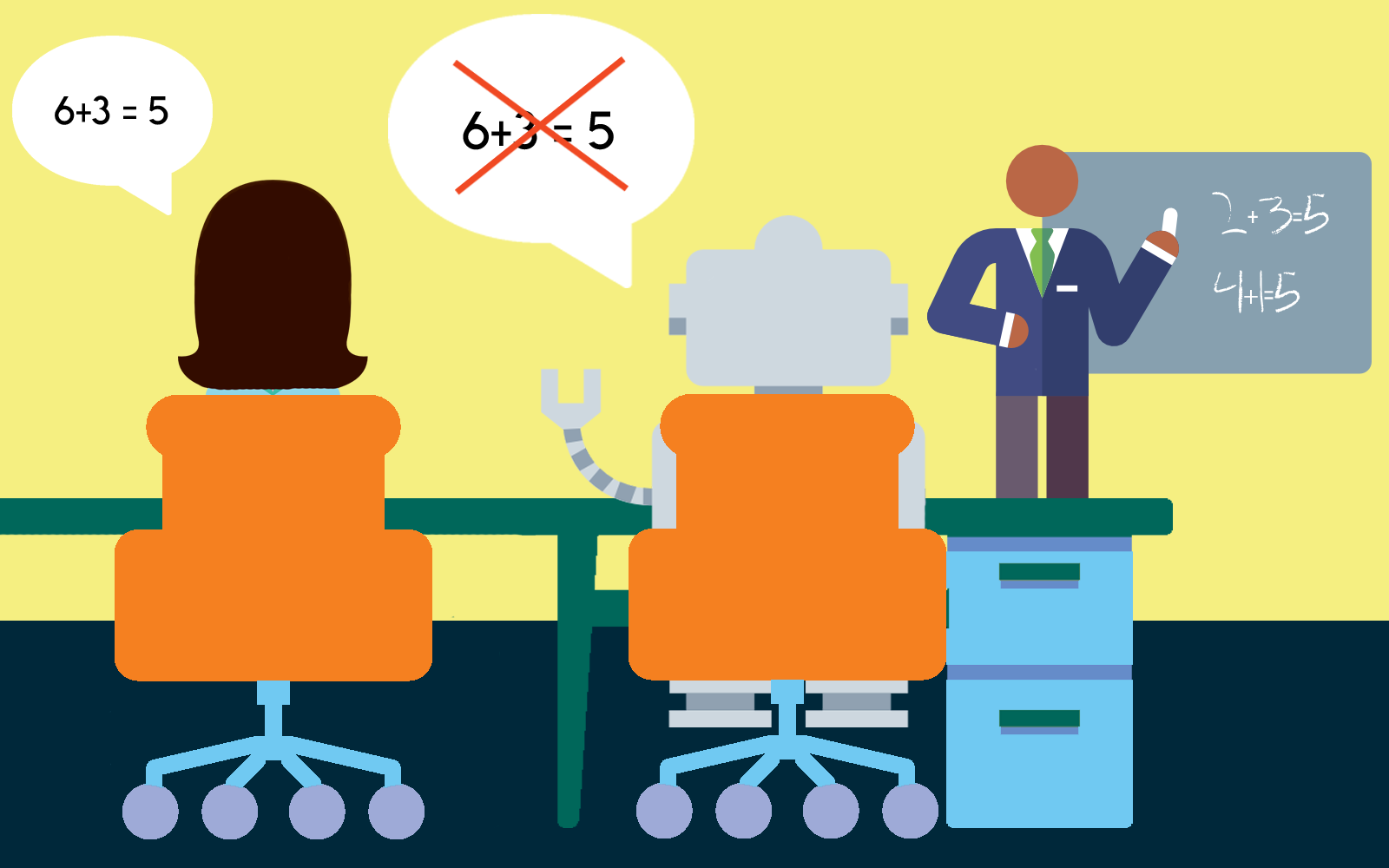
Supervised learning requires that the algorithm’s possible outputs are already known and that the data used to train the algorithm is already labelled with correct answers. It’s like teaching a child that 2+2=4 or showing an image of a dog and teaching the child that it is called a dog. The approach to supervised machine learning is essentially the same – it is presented with all the information it needs to reach pre-determined conclusions. It learns how to reach the conclusion, just like a child would learn how to reach the total of ‘5’ and the few, pre-determined ways to get there, for example, 2+3 and 1+4. If you were to present 6+3 as a way to get to 5, that would be determined as incorrect. Errors would be found and adjusted.
The algorithm learns by comparing its actual output with correct outputs to find errors. It then modifies the model accordingly.

Supervised learning is commonly used in applications where historical data predicts likely future events. Using the previous example, if 6+3 is the most common erroneous way to get to 5, the machine can predict that when someone inputs 6+3, after the correct answer of 9, 5 would be the second most commonly expected result.  We can also consider an everyday example – it can foresee when credit card transactions are likely to be fraudulent or which insurance customer is more likely to put forward a claim.

Supervised learning is further divided into:

  1. Classification
  2. Regression


2. Unsupervised learning

Supervised learning tasks find patterns where we have a dataset of “right answers” to learn from. Unsupervised learning tasks find patterns where we don’t. This may be because the “right answers” are unobservable, or infeasible to obtain, or maybe for a given problem, there isn’t even a “right answer” per se.

Unsupervised learning is used against data without any historical labels. The system is not given a pre-determined set of outputs or correlations between inputs and outputs or a “correct answer.” The algorithm must figure out what it is seeing by itself, it has no storage of reference points. The goal is to explore the data and find some sort of patterns of structure.

Unsupervised learning works well when the data is transactional. For example, identifying pockets of customers with similar characteristics who can then be targeted in marketing campaigns.

Unsupervised machine learning is a more complex process and has been used far fewer times than supervised machine learning. But it’s exactly for this reason that there is so much buzz around the future of AI. Advances in unsupervised ML are seen as the future of AI because it moves away from narrow AI and closer to AGI (‘artificial general intelligence’ that we discussed a few paragraphs earlier). If you’ve ever heard someone talking about computers teaching themselves, this is essentially what they are referring to.

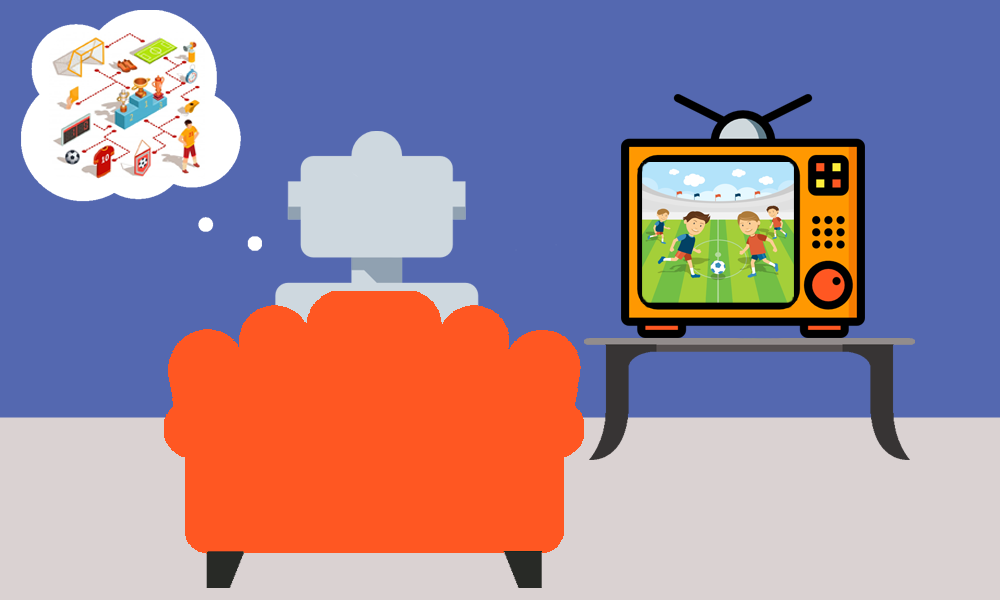
In unsupervised learning, neither a training data set nor a list of outcomes is provided. The AI enters the problem blind – with only its faultless logical operations to guide it. Imagine yourself as a person that has never heard of or seen any sport being played. You get taken to a football game and left to figure out what it is that you are observing. You can’t refer to your knowledge of other sports and try to draw up similarities and differences that will eventually boil down to an understanding of football. You have nothing but your cognitive ability. Unsupervised learning places the AI in an equivalent of this situation and leaves it to learn using only its on/off logic mechanisms that are used in all computer systems.
robot watching football on tv

3. Semi-supervised learning (SSL)

Semi-supervised learning falls somewhere in the middle of supervised and unsupervised learning. It is used because many problems that AI is used to solving require a balance of both approaches.

In many cases the reference data needed for solving the problem is available, but it is either incomplete or somehow inaccurate. This is when semi-supervised learning is summoned for help since it is able to access the available reference data and then use unsupervised learning techniques to do its best to fill the gaps.

Unlike supervised learning which uses labelled data and unsupervised which is given no labelled data at all, SSL uses both. More often than not the scales tip in favour of unlabelled data since it is cheaper and easier to acquire, leaving the volume of available labelled data in the minority. The AI learns from the labelled data to then make a judgement on the unlabelled data and find patterns, relationships and structures.

SSL is also useful in reducing human bias in the process. A fully labelled, supervised learning AI has been labelled by a human and thus poses the risk of results potentially being skewed due to improper labelling. With SSL, including a lot of unlabelled data in the training process often improves the precision of the end result while time and cost are reduced. It enables data scientists to access and use lots of unlabelled data without having to face the insurmountable task of assigning information and labels to each one.


4. Reinforcement learning

Reinforcement learning is a type of dynamic programming that trains algorithms using a system of reward and punishment.

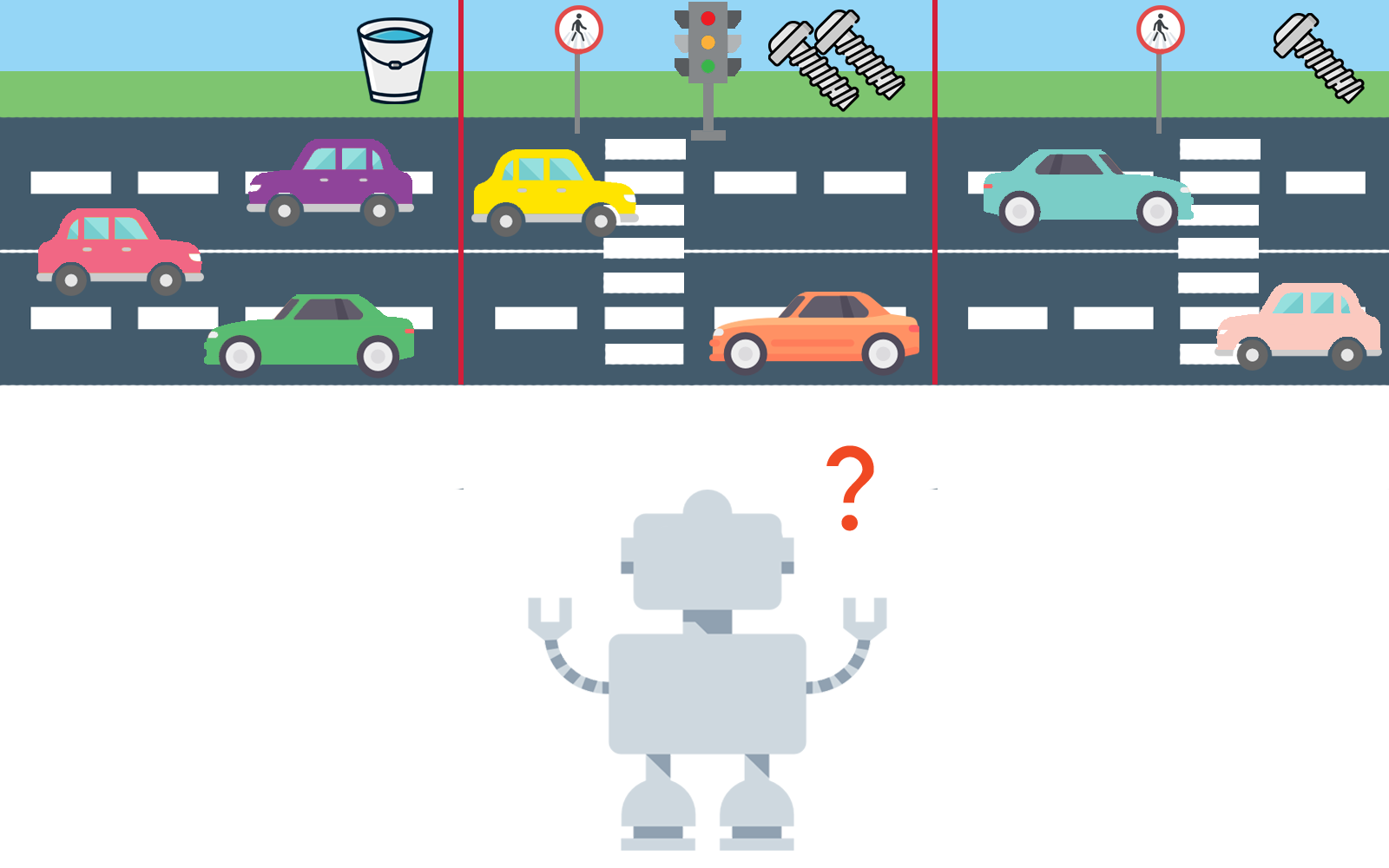
A reinforcement learning algorithm, or agent, learns by interacting with its environment. It receives rewards by performing correctly and penalties for doing so incorrectly. Therefore, it learns without having to be directly taught by a human – it learns by seeking the greatest reward and minimising penalty. This learning is tied to a context because what may lead to maximum reward in one situation may be directly associated with a penalty in another.

This type of learning consists of three components: the agent (the AI learner/decision maker), the environment (everything the agent has interaction with) and actions (what the agent can do). The agent will reach the goal much faster by finding the best way to do it – and that is the goal – maximising the reward, minimising the penalty and figuring out the best way to do so.
robot confused about where to cross the road

Machines and software agents learn to determine the perfect behaviour within a specific context, to maximise its performance and reward. Learning occurs via reward feedback which is known as the reinforcement signal. An everyday example of training pets to relieve themselves outside is a simple way to illustrate this. The goal is getting the pet into the habit of going outside rather than in the house. The training then involves rewards and punishments intended for the pet’s learning. It gets a treat for going outside or has its nose rubbed in its mess if it fails to do so.

Reinforcement learning tends to be used for gaming, robotics and navigation. The algorithm discovers which steps lead to the maximum rewards through a process of trial and error. When this is repeated, the problem is known as a Markov Decision Process.

Facebook’s News Feed is an example most of us will be able to understand. Facebook uses machine learning to personalise people’s feeds. If you frequently read or “like” a particular friend’s activity, the News Feed will begin to bring up more of that friend’s activity more often and nearer to the top. Should you stop interacting with this friend’s activity in the same way, the data set will be updated and the News Feed will consequently adjust.


Deep Learning

Deep learning is a specialized form of machine learning. Deep Learning is an artificial intelligence function that imitates the workings of the human brain in processing data and creating patterns for use in decision making. It is also known as Deep Neural Learning or Deep Neural Network.
Deep learning uses a hierarchical level of artificial neural networks for the machine learning process. These networks are built to resemble the way the human brain functions, with neuron nodes interconnected like a web. While traditional programs build linear networks, the hierarchical function of deep learning systems enables processing data in a nonlinear way.

A standard machine learning workflow starts with manually extracting selected features from images. These features are then used to create a model for categorising the selected objects. A deep learning workflow differs from this as relevant features are extracted automatically. In addition, deep learning performs “end-to-end learning” – it is given raw data and a task to perform, such as classification, and it learns how to do this by itself.

In machine learning, you manually choose features and a classifier to sort images. With deep learning, feature extraction and modelling steps are automatic.

However, because deep learning is still going through growing pains, there have been a number of concerns raised alongside the vast potential it holds, particularly around the ambition of achieving AGI through deep learning.

Gary Marcus, former head of AI at Uber, published a paper on deep learning which summarises some key concerns. Among the concerns he raised were:

  • DL is limited when it comes to open-ended reasoning based on real-world common sense and knowledge, meaning that machines wouldn’t be able to distinguish between “Tom promised Mary to stop” and “Tom promised to stop Mary”.
  • Deep learning is self-sufficient and is made up of correlations, rather than abstractions. Problems that deal largely with common sense reasoning are mostly outside of what deep learning can cope with.
  • Another problem often linked to deep learning is acquiring biases. If the training data set contains biases, the model will learn and consequently replicate those biases in its conclusions and predictions.

Despite the buzz surrounding deep learning, it is still a tremendous challenge. While great strides are being made in its progress, the journey of moving machine learning beyond pattern classification will be long and arduous.

So there you have it. We hope that now, should your next debate with friends or colleagues involve the differences between AI, ML and DL, you will stand proud. If not, we look forward to seeing Senator Cornyn-inspired memes about your blunder.

If you are looking for a new role where you can work within this field, or if you need fresh talent for your company or organisation – we would love to help.


[DISPLAY_ULTIMATE_SOCIAL_ICONS]


*certain icons in the images are created by the following FlatIcon authors: Vignesh Oviyan, Freepik, Dave Gandy, Vectors Market, Smashicons, Good Ware, Smartline, Iconnice, prettycons, Roundicons, Vector Pocket and Pixel perfect. 

Despite recording the highest number of attacks over the last year. UK business are better at minimising damage to the business

The estimated average number of targeted cyber attacks reported by UK organisations is almost 40% higher than the European average, according to new research from Quocirca and Trend Micro.

The Europe-wide research of 500 senior IT decision makers from organisations with over 2,500 employees has found that 64% believe that targeted cyber attacks on their business have increased over the past year, with a 61% increase in the UK.

However, whilst UK organisations report a higher average number of attacks within the last year (8.6 versus a European average of 6.2), they reported that these attacks were less likely to have been successful and that data was less likely to have been stolen.

The number of respondents believing these attacks to now be inevitable and/ or have been a concern for some time has risen sharply since 2013. In fact, the majority believe they will increase and 15% of respondents think this rise will be severe. Almost no UK businesses polled believe targeted attacks will decrease.

More than half of European (52%) and UK organisations (53%) feared that a cyber attack would have a serious impact on their operation. However, the majority of UK businesses said they had measures in place to mitigate for targeted attacks.

When targeted attacks on UK businesses have been successful, respondents recorded a lower overall average cost to the business. The average estimated cost of a cyber attack for a UK business is £172,000 compared to £243,000 for all Europe.

Although the UK is an attractive target for cyber criminals, this finding indicates that UK organisations are better prepared for targeted attacks than other European businesses.

UK organisations are ahead of their European counterparts in recognising the importance of having a breach response plan in place. More than half (51%) said that a breach response plan was very important, compared to a European average of 38%. This seems to be instrumental in keeping down the overall cost of breaches in the UK.

Across Europe, the most recent attack for the average organisation has occurred within the last three months (87 days), with the UK figure standing at 80 days.

“While UK businesses increasingly recognise the reality, scale and impact of targeted attack, the initial data reveals that much more can and should be done in testing their readiness to deal with them,” said Rik Ferguson, VP security research at Trend Micro. “A large number of businesses report having training and penetration testing measures in place, but relatively few are conducting cyber-readiness tests, or fire drills.

“Raising user awareness and probing your systems are both crucial components but they cannot be fully tested unless brought together in a live-fire exercise involving your employees.”

Bob Tarzey, analyst and director at Quocirca, added, “Initial analysis of the new data suggests UK organisations are better prepared. However, much more could be done by most UK organisations to prevent attacks and deal with the aftermath when some are inevitably successful.

“Some of those reported led to devastating data losses, the cost of dealing with which was way above the average.”


Source: Information Age

As a Consultant who specialises in the placement of virtualisation and cloud technology professionals, I speak with new and existing clients on a daily basis. One trend I’ve noticed when talking to new clients is the decrease in the use of virtualisation technology, and the increase in the use of the cloud.


The conversation usually goes something like this:

Me: “I know that VMware is a technology you use quite a lot in the business. I’m currently working with a number of VMware Certified Professionals who are interested in new opportunities and wanted to understand how the business could utilise such professionals at this time?”

Client: “We probably could do with another VMware specialist – but our plans are very much focused on moving to the cloud”


As a Recruiter, you need to embrace these trends and that’s why I’m building up my network of cloud professionals, while still servicing my existing clients who require the virtualisation professionals as it is still essential to IT infrastructures in small and large organisations.

I’m not a techy but I was interested in doing some research to find out why organisations are starting to question their use of VMware & Hyper-V technology?

It appears that the main factors in this trend are cost and the headache of legacy systems. The rise of “containers”, which are cheaper to use and born in the cloud so no installation problems, are impacting the dominance of virtualisation.

An example of a container is Docker. Docker containers wrap a piece of software in a complete filesystem that contains everything needed to run: code, runtime, system tools, system libraries – anything that can be installed on a server. This guarantees that the software will always run the same, regardless of its environment.

Containers and virtual machines have similar resource isolation and allocation benefits — but a different architectural approach allows containers to be more portable and efficient.

Containers include the application and all of its dependencies — but share the kernel with other containers, running as isolated processes in user space on the host operating system. Docker containers are not tied to any specific infrastructure: they run on any computer, on any infrastructure and in any cloud.

However VMware & Microsoft aren’t just standing still – they are embracing the change and recognise their market supremacy is under threat. For example, VMware has long been criticised for its proprietary approach to virtualisation but last year delivered their first open source container products.

The first of these were Project Lightwave which focuses on identity and access management, the second was Project Photon which looks at managing containers and VM’s on a single platform.

It’s going to be interesting to see how things develop in the battle for server virtualisation supremacy. But the fact VMware & Microsoft are taking a proactive approach to containers means they’re taking the threat very seriously.

– Phil

For more information on virtualisation and cloud technology market, contact Phil Lillicrapp

3D virtual skyscraper will entice kids as young as 12 with cyber security-related games and puzzles, then engage them with future employers.

The first ever virtual world designed solely to find, test and recruit cyber talent has been unveiled in London today.

Cyber Security Challenge UK, backed by the Cabinet Office, has launched ‘Cyphinx’, a 3D virtual skyscraper that acts as a gateway to recruitment opportunities, as well as cyber security games, competitions and ciphers.

The first collection of games for Cyphinx, which boasts the world’s first use of the Minecraft world to test cyber skills, has been developed by global technology companies Clearswift and ProCheckUp, and cyber hobbyists as young as 12 years old.

By combining always-on access to games and competitions that reflect the real-world skills cyber professionals use today, with learning materials and the chance to meet potential employers, Cyphinx is being pitched as the UK’s hub of cyber talent recruitment opportunities.

With the growing cyber skills gap and recent news that jobs in the sector can pay over £100,000 a year, cyber security is an exciting career option. But traditional recruitment methods have proved ineffective and employers have sought new ways to find, test and appeal to fresh talent.

The Cyphinx virtual skyscraper, hosted by Skyscape Cloud Services, has been developed in conjunction with the Serious Games Institute to look like a high quality 3D console game.

Candidates can create avatars, enter the building, interact with other candidates and engage with potential employers.

As they work their way through the games, players’ scores are entered onto leader boards for security-related disciplines such as risk analysis, forensic analysis, network defence and ethics, allowing them to showcase their skills and create a digital CV in the process.

Leading employers supporting the project include SANS Institute, BT, GCHQ, QinetiQ, Northrop Grumman, BAE Systems, Airbus, National Crime Agency, IRM, Raytheon, PWC, PGI, Bank of England, National Grid, HMGCC, and ProCheckUp.

To reflect the real world of cyber skills as accurately as possible, Cyber Security Challenge UK has encouraged these supporters to help create the games, ciphers and puzzles.

“The UK has a thriving digital economy so there's a huge demand for people to join the cyber security profession and help protect our businesses,” said Ed Vaizey MP, Minister of State for Culture and the Digital Economy. “Government is committed to encouraging young people to consider cyber security as a career, and this new 'virtual world', developed by the Cyber Security Challenge, will help ensure the UK develops the cyber experts of the future.”

Stephanie Daman, CEO at the Cyber Security Challenge, added: “Amidst the chronic shortage of cyber professionals, there is a wealth of talent which is still untapped. Over the last six years we have made it our mission to find these individuals, using the best, most innovative methods.

This is the next logical step to inspire an audience who may not yet even know that cyber is the career for them. By harnessing industry, government and candidate knowledge and expertise to find talent in new and innovative ways, we’ve created a world first – a virtual community that can be accessed whenever our candidates desire.”


Source: Information Age


64% of UK Business leaders are concerned that potential employees do not have the necessary skills to realise the ambitions of their business according to a recent study carried out by international professional services firm PwC. The research, in which more than 1,300 employers were asked about their hiring intentions over the next 12 months, also revealed that a quarter of business leaders plan to increase their workforce by up to 5% in the coming year, with a further 20% planning increases of up to 8% and a further one in five planning increases of over 8%.
 
Technology and engineering firms are the ones to report the most drastic shortage of skilled talent. This has led businesses to ask for help from the UK government to try and fill the skills gap in the market. Two-thirds of those asked say that combating the skills shortage should be the joint top priority for the government along with ensuring there is stability in the financial sector and access to affordable capital. However only a mere 7% think that the government has been successful in achieving these priorities. 
 
For more information on the research carried out, click here.
A BA’s role will vary depending on each organisation or project, but understanding the nature of the business problem is an essential skill.

According to the latest issue of Analysts Anonymous a good BA will ask a lot of questions, work well as an individual and as part of the team, and really understand what a business’ requirements are through careful planning and evaluation. Failure to assess the business problem can mean BAs don’t deliver the required solutions on time and to a high standard.

Questioning and listening are fundamental to gaining this understanding and the BA must demonstrate the following qualities to succeed:

  • Genuineness – be interested in what is being said to establish a good relationship from the offset.
  • Respect – showing respect to the individual and their personal views is key to gaining their trust.
  • Understanding – a clear understanding of the subject matters being disclosed will assist in identifying the problems that are hindering the growth of a company.
  • Questions – using open questions will allow for more detail to be gained whilst closed questions will round off the debate. Putting the negative emphasis on yourself when you have not fully understood will provide an opportunity to ask more detailed questions.

More guides, tips and opinions about the BA function can be found in our regular publication Analysts Anonymous.

A report published by the government and one of the UK’s leading insurance brokers and risk advisors, Marsh, has announced plans for the UK to become a global leader in cyber security insurance through a series of initiatives designed to help firms get to grips with cyber risk.

The Cabinet Office minister and 13 major insurance firms have agreed to work together to improve the availability of cyber insurance by UK companies, after the report highlighted that 81% of large UK based companies, and 60% of small companies have suffered a cyber security breach in the past year.

Research suggests that cyber threats cost the UK economy billions of pounds each year and companies have been advised to ensure that they treat the danger as a commercial risk that affects all parts of a business.

Marsh UK & Ireland chief executive Mark Weil said: “Companies will need to upgrade their risk management substantially to cope with the growing threat of cyber attack, including introducing disciplines such as stress-testing, and creating a joined-up recovery plan that brings together financial, operational and reputational responses.”

Cyber security jobs at Certes

For more information on cyber security job roles with Certes, please search jobs on our site.

The US and UK have many similarities and differences on how they conduct business. one such difference is in recruitment. The US and UK value and prioritise different aspects of the recruitment process.

But what are the differece between the US and UK in recruitment.


Source: Jobvite