After a hard few years the UK economy is starting to bounce back. What recent finding has uncovered is that even with the slow growth of the UK economy, the technology sector is growing quicker.

The technology sector job growth has hit an all time high for Q1 2015 and is stronger compared to that of the UK as a whole and increased to almost a quarter since 2010.

The technology sector employment PMI has risen from 55.3 from 2014 to 57.8 by the Q1 2015 as KPMG addresses this towards companies taking on extra staff due to planned expansion and “new product launches and forecasts of stronger client demand”. This increase in employment comes during a time of slow business growth in the technology sector “partly linked to delays with clients’ decision making ahead of the general election”.


As the KPMG reported, the technology sector has been a crucial driving force across the UK in the private sector for job creation and this sector is outperforming the employment growth of the UK as a whole since 2007/08, during the beginning of the recession with an estimate of 1 million jobs in the technology sector.

This trend is expected to continue with “the IMF forecasting a 2.7% expansion of GDP this year, up from 2.6% in 2014”.

Source: KPMG.co.uk/ Tech Monitor

You can read more about the survey from KPMG.

For more vacancies in numerous IT roles visit Certes. Certes have a broad range of IT job opportunities to choose from in various sectors.

This weeks Cyber Insights from The National Cyber Skills Centre.

Is the explosion of social media and the availability of personal information placed online causing more cyber fraud? The answer is yes, but it’s unfair to lay the blame entirely at the door of social media.

Read more, visit the National Cyber Skills Centre: Cyber Insights

Certes specialise in IT staffing for all sectors and industries. We are now working with the National Cyber Skills Centre in order to provide staffing to companies in need of cyber security. For cyber security jobs search our available jobs.

From social media’s humble beginnings as a way for friends to keep in contact with each other and share online content, social media is fast becoming a tool that all businesses use. So it’s no surprise that the fast, wider reaching tool is now being used as a method of recruitment, but can recruiters focus their strengths on using social media platforms as their recruitment tools and forget about using traditional procedures such as job boards?

According to Recruitmentbuzz.co.uk (LINK) a huge quantity off recruiters use social media “61.5% use LinkedIn, 30.7% use Facebook, 23.1% use Twitter, and only 7.7% are using only job boards” it’s clear to see that social media is becoming the ‘go to’ platform for recruiters with LinkedIn sitting high on the top spot . LinkedIn possess many benefits for recruiters being “very similar to a standard job board… it provides more insight on a candidate’s interests and views based on groups they join, articles they read, or even articles they may write.” Recruitmentbuzz.co.uk (LINK).

A recent study (LINK) shows that 73% of recruiters have hired candidates from social media, and 79% of those candidates came from LinkedIn. The study also continues to explain that 93% of recruiters review a candidate's social profile before making their final decision.

Can social media provide good quality candidates? Software Advice (LINK) an HR Technology review company’s finding’s shows that LinkedIn provides 40% High quality candidates compared to Job Boards who provide lower high quality candidates, under 20% lower than LinkedIn.

 Source: Recruiting software review company Software Advice

Though the research has placed using social media in high regards this does not mean that traditional job boards should be forgotten. Job boards still provide high quality candidates to clients. Using both means is advantageous but the success of social media will depend on the role and the industry.


And while we are on the subject of social media, be sure to follow Certes on our social networks.

LinkedIn – Certes LinkedIn

Twitter – @CertesNews

SQL topped the most sought-after skills list across both permanent and contract roles in the winter edition of Certes’ 4Sight skills review.

Java and Oracle were also in demand in the contract sector, while Microsoft and .NET were sought-after amongst permanent roles.

Twitter Bootstrap saw the highest increase in demand in the contract sector, followed by Windows Server 2012 and big data, while the biggest increase in demand from the permanent sector came from ASP .NET WEB API, Twitter Bootstrap and cyber security.

Banking and finance offered the most opportunities across both permanent and contract roles, with telecoms, e-commerce, retail and marketing also showing high demand for IT professionals.

Developers, analysts and project managers were the most demanded job functions, while SQL was the most in demand programming language, followed by Java, HTMP, .Net and SQL server.

To find out more about the most sought-after IT skills and the latest rates and salaries, sign up to receive Certes quarterly 4Sight review.

Recently an IT BP contact got in touch with me with the following question:

I've just read a piece of research where it spells out the ways CIOs are looking to get engaged in underpinning their organisations' business strategies.  In doing so they're performing a lot of things we're expecting a BRM to do.

This reminded me of my early years at XX when, as a BRM, I seemed to continually 'step on the toes' of the then CIO who was also seeking a seat at the top table and, consequently, felt threatened by me.

In your opinion, what can CIOs and BRMs do to work together in a more cooperative, rather than competitive way?

My response to him was as follows:

In my opinion, the CIO should be the most senior IT BP in the IT function. If that is not the case (as in your example) the IT BP should identify the CIO as one of the key five stakeholders that require your immediate and significant investment and spend the time building a level of trust, to ensure the CIOs full understanding of the IT BP role and what value you bring.

Without that buy in (and such buy is going to have to be instigated by the IT BP, not the CIO), I would question the ongoing success of the function.

Since my initial response I’ve also considered the following:

  1. My contact’s example was from a number of years ago (early 2000s) when the IT BP role was less established, less mature and more misunderstood.  Surely such a situation does not exist today?  Or does it?
  2. Does the community agree with my initial response?  Should the CIO be one of the top five stakeholders that require immediate and significant investment by the IT BP?  Are there other (better) ways that people can share?
  3. If you are unable to get buy-in from the CIO despite your best efforts, is it a good idea to update the CV?
  4. My contact refers to the top table which seems to be the end goal for most in the IT BP community.  Do we need to be at that top table? Not everyone thinks so.
  5. Finally, what does the IT BP community think?  What can CIOs and IT BPs do to work together in a more cooperative, rather than competitive way?


Your thoughts and comments are, as always, welcome

– James O’Driscoll BRMP®

james.odriscoll@certes.co.uk

A visual look at some of the statistics, themes and responses from the 2015 CIO 100

Source: CIO UK

A short while ago we wrote about how the IT staffing has been seeing a huge growth, despite the slow growth of business.Below, Apsco continue on this topic and also explain how the recent elections have affected employment.


  • Year-on-year figures show professionals seeking new roles increase by 59%
  • Month-on-month figures show an increase in both professional opportunities (up 14%) and in professionals seeking to move (up 28%)
  • Average salary change for those securing new positions increased to 19%

?

A Strong April

“We’ve seen increases from every angle; month-on-month, year-on-year for both job opportunities and those seeking new roles” says Hakan Enver, Operations Director, Morgan McKinley Financial Services. “This is in line with what we predicted last month. With bonus rounds coming to a conclusion at the end of the first quarter, April is typically a month where we see people actively looking for new roles.”

Growth in opportunities has continued to strengthen with a month-on-month increase of 14%. “From a job availability perspective, there has been some replacement, but there is a clear underlying trend of growth”, said Enver.

Yearly figures for job opportunities saw an increase of 17% with those seeking new roles showing a big jump of 59%.


Elections

The upcoming UK elections were the main theme throughout April. Despite jitters within the financial sector about the possible negative effects of a hung parliament, the actual impact on hiring was negligible. “The data shows that in the lead up to the elections hiring was not affected as many had predicted. In actual fact, the data clearly shows the opposite”, said Enver.

A key theme during the elections and particularly pertinent to the financial sector, is the UK’s future relationship with the European Union. [At time of writing, the UK election results showed that the Conservatives had won a majority vote and will serve another term in parliament.]

“As mentioned last month, most city professionals are against a UK exit from the European Union (EU), whilst remaining supportive of Conservative policies. Now that the Conservatives have regained full control, they are committed to a referendum on the Brexit in 2017. As a result, the debate about the UK remaining as part of the EU will become a major subject of interest for the financial sector.”

In a study published by the Centre for the Study of Financial Innovation (CSFI) surveyed over 400 financial services executives which found that the financial community is far more supportive of staying in the EU than the general public. With nearly three quarters of the financial executives polled saying they would either “definitely” or “probably” vote to stay in the EU.

“The majority in the City are clearly in favour of maintaining a relationship with our European counterparts. This is purely from a business perspective provided that the UK has more power and more autonomy running their businesses. Therefore, not necessarily completely dictated by those from abroad”, said Enver.

The results of the CSFI research are in strong contrast to a study conducted by Populus in April, which found that the British electorate deeply divided with 40% saying they wanted to remain in the EU, 39% wanting to leave and 17% undecided.

“The CSFI study appears to support the idea that the UK financial community’s attitude to the EU is based on pragmatism and the fear of the unpredictable ramifications of a Brexit.” Enver continued, “By completely breaking from the reigns of the EU, there could be a longer term impact to business in the UK. Not only would it create a  threat of jeopardising the trading alliances with the eurozone, but also the UK’s alliances with the US and the Middle East would be thrown into question. Equally, if the UK was to successfully renegotiate terms, there would be a considerable cost to the EU as a whole.”

The UK currently makes up over 10% of the total EU population. Figures from the Office for National Statistics show that in 2013, the net figures (which take into account the UK’s rebate) showed the UK’s overall contribution standing at a mammoth £11.3 billion to the EU.


Graduate Survey

As the number of jobs on offer continues to grow, there has been an increased focus on graduate hiring. Morgan McKinley conducted a study of 157 hiring managers to discuss the effects that the financial crisis had on hiring and their views on the current challenges they face.

The study found that 53% of companies felt no impact on their graduate hiring as a result of the financial crisis, with 9% even increasing hiring. In the current market 50% of respondents said the financial crisis no longer had any impact on their graduate hiring.

“There has been much discussion around the negative impact of the financial crisis on graduate hiring, but our data doesn’t support this. Exactly half said that it impacted their graduate hiring” explains Enver. ”If anything, it shows the UK finance sector as being resilient, even in the midst of a historical crisis.”


Data Graph 1

Data Graph 2


The future is also looking positive for graduates with a combined 68% of respondents stating that the biggest current challenges are a skills gap shortage (47%) and lack of future talent (21%).


Data Graph 3


Average Salary Increases

The average salary change registered in April 2015 was 19%. “With improved confidence, there’s still a trend to expect a far greater salary increase when moving roles and thus it is a major contributing factor to people looking for new opportunities”, said Enver.


Data Graph 4

Data Graph 5

Data Graph 6

Original Source: Apsco.org

If you want to capitalise on the continued employment trend improvements visit Certes IT recruitment website were you can find job roles in IT a variety of sectors and industries.

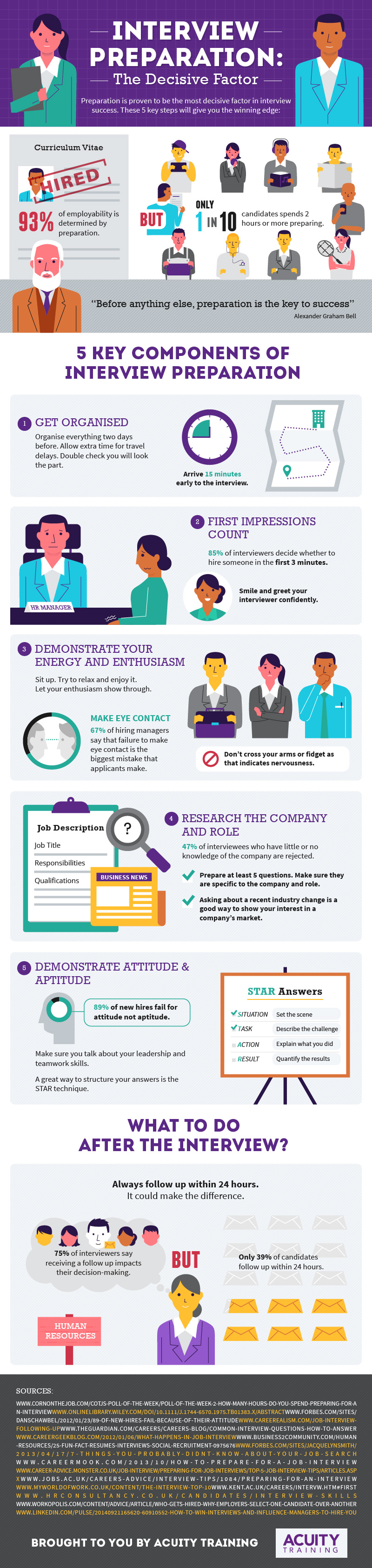
Going into anything unprepared could be the thing for your failure. If you are going for an interview preparation is the key to winning as 93% of employability comes from preparation.

For an interview, a lot of areas need to be prepared for from travel time, first impressions to body language. This is all things that can affect your interview for better or worse depending on how much that you prepared for it.

A big area that you should definitely prepare for is what the company you want to work for does. 47% of interviewees who do not research the company are not hired.


You should prepare for these five areas for every interview that you go to. Preparation will help you to make a great first impression to your future employer and could steer the entire interview in your favour. It will also help you to control your nerves better and become more comfortable during the interview. 

Source: social-hire.com

  • Permanent vacancies show 0.3% growth year-on-year
  • Contract vacancies slide by 5%
  • Demand for contractors in IT falls by 13% 
  • Average salaries dip by 1.4%      

PRT LogoProfessional recruitment firms reported that vacancy numbers flatlined in November with the number of permanent vacancies rising by just 0.3% year-on-year according to new survey data from the Association of Professional Staffing Companies (APSCo). This is in line with the latest data from the Office for National Statistics (ONS), which reported in December that employment levels across Britain dipped for the first time in a year and a half in a sign that the UK jobs market is losing steam following the EU referendum.

The ONS data shows that overall employment stood at 74.4% in the three months to October, marking the first drop since February to April 2015 triggered by a 6,000 fall in the number of people in work.

APSCo data, which focuses on professional recruitment, reveals notable variations between the trade association’s core sector groups in terms of hiring activity. While permanent vacancies across both financial services and marketing, for example, have increased (1% and 13% respectively), IT and engineering have both recorded dips of 5%.

Contract vacancies slide 

Demand for professional contractors contracted by 5% across the board year-on-year. Engineering was the only sector which enjoyed modest growth, with vacancies increasing by 1%. Demand for IT and finance professionals recorded the sharpest drop in demand with vacancy numbers falling by 13% and 7% respectively.

The drop in vacancies for IT contractors was partially balanced by a 5% increase in permanent roles, which suggests that organisations are slowly moving away from the short-term approach to hiring which was adopted after the referendum. The Confederation of British Industry has predicted that the IT sector will enjoy some of the highest levels of job creation in 2017.

Average salaries down

APSCo’s figures also reveal that median salaries across all professional sectors dipped by 1.4% year-on-year. This figure is characterised by notable fluctuations in terms of sector, with marketing, for example, recording an uplift of 1.6% while in banking average salaries were down 7.7% year-on-year.

Ann Swain, Chief Executive of APSCo comments:

“As the starting date for negotiations over leaving the EU approaches, it seems that employers are taking a slightly more cautious approach to hiring. However, while permanent vacancies remain largely resilient, demand for contractors has dipped.”

“As is often the way in times of uncertainty, the run-up to the referendum and immediately after, employers turned to a contingent workforce to keep the wheels in motion. Now hiring managers are re-adjusting to the new landscape and taking a breather so that they can plan workforces strategically moving forwards.”

“Despite the less than rosy picture these latest figures project, the UK employment rate remains high and research from the Confederation of British Industry (CBI) suggests 41% of companies expect to grow their workforces in 2017, compared with just 13% that believe their payrolls will shrink.”

Source: Apsco.org

  • Permanent vacancies show 0% growth year-on-year
  • Contract vacancies within financial services jump 8%
  • Engineering vacancies fall by 7%
  • Demand for marketing professionals up 15%
  • Average salaries fall by 0.8%   

Download the FREE Infographic  

PRT LogoProfessional recruitment firms reported that vacancy numbers flatlined in September with the number of permanent vacancies remaining unchanged year-on-year according to new survey data from the Association of Professional Staffing Companies (APSCo). This is in line with the latest data from the Office for National Statistics (ONS), which reported in October that the overall employment rate stabilised at 74.5% in the three months to August 2016 – representing no change in percentage points when compared to the three months to July 2016.

The latest data from APSCo reveals notable variations between the trade association’s core sector groups in terms of hiring activity. While permanent vacancies across both financial services and marketing, for example, have increased (4% and 15% respectively), IT and engineering have both recorded dips of 7%.

Opportunities within financial services remain strong 

Despite warnings from the British Bankers’ Association (BBA) that financial services institutions are poised to relocate to Europe over Brexit, opportunities within the sector remained strong in September. Permanent vacancies across financial services increased by 4% in the year to September while opportunities for contractors increased by 8% over the same period. While finance remains the most buoyant sector for interim roles, the latest figures suggest that demand is beginning to stabilise following a spike post-referendum. In September we reported that contract roles had increased by 16% year-on-year in August.

Engineering vacancies dip

Permanent vacancies within the engineering sector dipped by 7% year-on-year in September. This is despite the fact that UK manufacturing activity grew at the fastest pace in more than two years in September, with the Markit/CIPS manufacturing Purchasing Managers’ Index (PMI) rising to 55.4 from 52.1 in August. This hesitancy to bring on board talent is likely to be attributed to sector-wide concern over the impact that leaving the single market will have on not only UK exports but also the availability of talent. This may explain high-profile job cuts across the sector, with Bombardier announcing it will cut another 7,500 jobs worldwide, which has raised fears for its British aerospace and rail workforce, while Fujitsu will cut almost 2,000 UK jobs as it looks to slash costs.

Demand for marketing professionals up

Demand for permanent marketing professionals increased by 15% year-on-year in September while interim vacancies rose by 3% over the same period. This is in line with a recent report from advertising and marketing trade body, the IPA, which found that employment prospects and marketing budgets were both up in the third quarter as companies commit new marketing resources to maintain brand awareness and competitiveness, particularly in overseas markets.

Average salaries up 

APSCo’s figures also reveal that median salaries across all professional sectors increased by 0.8% year-on-year. This figure is characterised by notable fluctuations in terms of sector, with insurance, for example, recording an uplift of 12.4% while in banking average salaries were down 4.4% year on year. Average salaries within the professional sectors fall short of the national increase in pay as reported by the ONS which found that earnings grew at an annual rate of 2.3% in the three months to August 2016.

Ann Swain, Chief Executive of APSCo comments:

“With the huge ambiguity around what Brexit will eventually look like and the associated volatility in the price of sterling, it is hardly surprising that professional hiring is flatlining. However, conversations with our members have confirmed that businesses realise that whether the UK is eventually inside or outside of the single market of goods and services, we must keep the wheels in motion and the spread of vacancies across various professional sectors is indicative of how businesses are preparing for the UK’s eventual exit.”

“With its huge reliance on overseas relationships, it’s no wonder that recruitment activity within manufacturing and engineering has slowed. However, the prognosis for opportunities in this area moving forward remains good, with the recent confirmation of UK-based contracts to build carriages for the Greater Anglia franchise, as well as orders to build new London Overground trains amongst others.”

“While vacancies within financial services have remained strong in recent months as companies draft in experts to prepare for a new legislative landscape, it seems that organisations are now thinking more holistically about their Brexit defence strategies. A surprise post-referendum success story is the marketing sector, which can likely be attributed to the increasingly influential role that marketing plays in driving British output growth. It seems that organisations are realising that investing in marketing talent is crucial to remaining competitive in increasingly uncertain times.”

Adam Pode, Director of Research for Staffing Industry Analysts, which compiles the report for APSCo, comments:

While we have yet to see a discernible BREXIT effect, there may be an increase in temporary vacancies and a converse decrease in permeant hiring as the uncertainty of what is going to happened over the next couple of years becomes more certain.

In the IT space, as we allude to in our report, there is also great concern over Fujitsu’s announcement that it is cutting almost 2,000 UK jobs early next year. According to the company, this is so it can remain competitive with foreign rivals that can offer services more cheaply. What is particularly concerning for the sector is the company is adamant that, “These changes are in no way linked to the decision by the U.K. to leave the EU”.

The former Chancellor, George Osborne, often spoke about the need to “rebalance” the economy away from financial services and towards manufacturing. Despite the fall in the value of sterling, this month’s figures seem to indicate that this is far from happening.”

Source: Apsco.org