I caught up with an old contact recently and we were discussing how the IT landscape has changed over the last few years as more functions are becoming engaged at a business strategic level rather than the traditional order taker.  What I found very interesting was my contact’s view of certain functions being more successful at this than others. He highlighted that, in his opinion, Enterprise Architecture as a department is very much established and on “ the executive's radar” whilst Business Analysis has typically not reached this level.

This raises the question: what can BRM departments learn from other functions which will help them become more established at an executive level?

Comparing Enterprise Architecture and Business Analysis , the duties/ deliverables for both roles are, according to Wiki:


Enterprise Architect (EA)

  • Alignment of IT strategy and planning with company's business goals.
  • Optimisation of information management through an understanding of evolving business needs and technology capabilities.
  • Strategic responsibility for the company's IT systems.
  • Promotion of shared infrastructure and applications to reduce costs and improve information flow. Ensure that projects do not duplicate functionality or diverge from each other and business and IT strategies.
  • Work with solutions architect(s) to provide a consensus based enterprise solution that is scalable, adaptable and in synchronisation with ever changing business needs.
  • Risk Management of information and IT assets through appropriate standards and security policies.
  • Direct or indirect involvement in the development of policies, standards and guidelines that direct the selection, development, implementation and use of Information Technology within the enterprise.
  • Build employee knowledge and skills in specific areas of expertise.


Business Analyst

  • Business requirements, i.e. business plan, key performance indicator, project plan…
  • Functional requirements, i.e. data models, technical specifications, use case scenarios, work instructions, reports…
  • Non-functional requirements
  • As-is processes, e.g. data flow diagrams, flowcharts
  • To-be processes, e.g. data flow diagrams, flowcharts
  • Data models, i.e. data requirements expressed as a documented data model of some sort
  • Business case, a strategic plan containing shareholders' risk and return


I’ve highlighted in bold the elements I believe have links/commonality to the BRM role, which has led me to the below conclusions and further questions. 


1.BRMs can learn a significant amount from EAs for various reasons:

a. There is a significant commonality between the two positions.

b. EAs are now generally established at the business strategic level. How have they done this and what can BRMs learn from EAs to help them reach this level?

c. What tools (or elements of tools) are available to EAs that can also be utilised by BRMs to help them along this journey?

2. Where does the EA roles end and the BRM roles begin? Do the roles/functions need to consider merging?

     3. Business Analysis, whilst sharing less commonality, is an established function with established tools including              those within (high level) business requirements and business cases.  Such tools can help BRMs also become              more established and need to be utilised.  

     4. What other established functions can BRMs tap into?  Other business partnering functions? PMO?  Who else?                                         

There is a strong desire in the BRM community to become more established at the business strategic level and whilst specific tools and procedures are available to achieve this, we shouldn’t forget there is also a fountain of knowledge available to us via peers in different functions, some of whom have already successfully achieved what the BRM community is looking to accomplish.

All computer science jobs are not created equal. That degree might qualify you for a number of different jobs in technology. But how do you know which one is the best for you?


Computer Jobs
Source: ComputerScienceZone.org?


‘Managed Services’ has become somewhat of a buzzword, with article headlines urging companies to move towards what they call the ‘modern model’. But underneath the entire buzz, for many of us, the question still remains– what are managed services and what are they good for? This is the question we at Certes will aim to answer clearly and in enough depth to give you a better grasp of how managed services work and the pros and cons for both clients and providers.

In a nutshell, a managed IT service is an information technology task provided by a third-party contractor for a client organisation. Managed services can be tailored to almost any business requirement within IT. Managed Services frequently comprise running applications, databases, data recovery and back-up, network management, storage, security, and monitoring. However, not all managed services are technology-based, despite that being the most widespread use of the term. At its most basic level, a managed service is an outsourced business need which may even cover things like marketing and transportation.

A managed IT service comes with a service-level agreement (SLA), which is the contract between the service provider and the customer. The SLA identifies what services the provider will supply and how successful delivery of services will be measured.

Within this model, the client owns or has direct oversight of their organisation or system. The managed services provider (MSP) is the service provider delivering the managed services. The client and the MSP enter into a contractual, service-level agreement that defines the performance and quality metrics of their relationship.

What are the benefits of Managed Services?


  • Enabling business agility and adaptation. Managed services are emerging as an invaluable strategic asset that aids enterprises in adapting more quickly to changes in the market. This is achieved by allowing quick access to new capabilities via cloud services, such software as a service (SaaS), platform as a service (PaaS) or infrastructure as a service (IaaS). In addition, access to data and analytics is enabling enterprises to better assess current and future business needs.


  • Optimising productivity and performance. While managed services open doors to accessing specific talent, cloud capabilities help to improve employee productivity and efficient use of resources. Cloud capabilities are also utilised to focus enterprise needs by requirements of each business unit and specific systems of engagement (e.g., sales, marketing, customer support).


  • Ensuring integrated, end-to-end “hybrid” IT service delivery and management. Companies also are using managed services as a way of receiving support across a hybrid of IT linking traditional delivery models and up-and-coming cloud-based options, which are far more automated.


Pros and Cons of Managed Services

Pros

  • Because the provider is responsible for the delivery and management of stakeholder expectations, the client business can fully focus on their core strategic initiatives
  • Providers can have more autonomy and benefit from a fairly disturbance-free supervision of the project.
  • Providers will be able to make long-term strategic investments that should indirectly benefit the client organization.
  • Providers are able to implement their best practices into the project, and therefore make key process improvements rather than having to fit into a rigid existing framework.
  • Knowledge retention becomes more streamlined and sustainable.

Cons

  •   Providers can be disinclined to take on additional management duties
  • There can be a culture incompatibility between the client and provider organisations which can lead to a lack of understanding or a breakdown of collaboration between the two, which in turn can have an impact on outputs and deliverables
  • In some situations, because they are external to the organisation, providers will not be able to understand all of the client organisation’s problems, pain points and worries. They may also struggle to fully grasp the scope of the project, which might result in significant delays and setbacks.
  • Where there are multiple managed service providers, with each managing a different part of the organisation’s IT requirements, it is not uncommon to find an approach of shifting blame, with providers being unwilling to take responsibility for disappointments and failures.
  • Despite process improvements bringing great benefits, a potential disadvantage of such improvements is a reduction in the number of people necessary to support the project. This is a drawback for the providers who may lose out on billing due to a reduced requirement of service.
  • The client may wish or need to re-allocate the contract to a new managed services provider, perhaps in part due to issues in performance or the SLA not being honoured. This is likely to become a significant challenge for the client, because the existing provider may become hostile or less co-operative.

On the whole, managed services are a great asset to any modern organisation, with opportunities to benefit in a multitude of ways. An MSP can lead to significant reductions in costs. Most providers will charge an upfront fee and then an ongoing fixed monthly fee, which provides clients with a set monthly expenditure, making financial planning much easier. Outsourcing managed services also allows business owners to reduce the cost of employees working in-house as well as the technology, tools, and other resources needed to handle the tasks.

Secondly, the managed service provider will bring the knowledge, expertise and experience in their service offering that will enable increased accuracy and decreased risk and liabilities, especially since they have to ensure compliance with government regulations and various industry standards.

Third, the MSP will have the tools, technology, and resources required to improve efficiencies by streamlining procedures and various processes. This can then lead to increased transparency and better understanding, which will then provide a foundation for stronger decision making based on factual, real-time statistics and information.

Content: Share This

We have seen what consultants look for in candidates, but this is a two way street. Candidates expect many things from the agencies that they interact with. Here, candidates who have used agencies share what they look for in an agency. Certes have asked  people who have dealt with agencies to find out thier views and what they look for.


“The most important thing that I look for in an agency is the ability to provide me with regular work that suits my needs i.e. workplaces within reasonable commuting distance, that treat employees and agency workers well. The agency should provide access to both long and short term roles and provide career professional development opportunities so that I am able to continue to enhance my skills while working for them. Agency recruitment staff should be friendly and have good interpersonal skills that make it clear that they are focused on finding you the right job opportunities. Agencies should contact you regularly with job opportunities that may be of interest to you based on their knowledge of your needs and requirements”.

Anonymous, Science Teacher

“As a job seeker and speaking with numerous agencies, the agencies that I return to are the ones that actually make an effort to contact me personally with new opportunities that match my skills. Multiple time agencies have notified me about openings that are not what I am looking for and that makes me feel that they are not interested in my needs and are only trying to fill jobs. An agency that takes time to find out what my ideal job is and informs me of any jobs available that fit what I want is what I look for in an agency”.

Andrew Robinson

“An agencies main job is to place people in jobs. I feel that this help should extend further, such as advice. Problems that I and other people may have come across are CV’s that are not up to scratch. Agencies should recommend changes to CV’s that would help improve chances of being selected for vacancies I have applied for. I know Agencies go through hundreds of CV’s a week, they are the best person to go for advice and tips to improve a job seekers CV”.

Kalvin Higgins, Alloy Refurb Specialist

“I work within IT and as such I possess many technical skills. The agencies that I go to need to have knowledge of these skills, if they don’t I have no faith that they will find jobs catered to me. As well as industry knowledge, agencies should keep me up-to-date on the progress of my application. There’s nothing more frustrating to me when dealing with agencies than being informed of a job that they think I would be perfect for and that I have applied to, to not hear anything back. A phone call or an email to let me know if I have been considered by the employer with feedback would help. This would give me information on what employers are looking for and would also give me a chance to see the areas that I may need to improve on in both my skills and CV”.

Imran Ebrahim, IT Manager


“Having the option to do an interview over the phone is something that I look for in an agency. Some agencies that I have used have asked me to come into their offices for an interview. I do not have a problem with making the journey but when the agencies are located in different regions of the UK it can be difficult to make the journey, for instance, travelling to Manchester from the West Midlands. Agencies should be aware of my location to where there office is so we can either arrange a mutual meeting location or we can arrange a time where we can discuss my background and what I am looking for over the phone.”

Anonymous, Marketing Executive

We are becoming more and more connected. Being able to control home equipment away from the home and working away from the office. All of this makes our lives easier and encourages us to be more efficient.

We are all aware that an always connected society has its negative points to coincide with the smorgasbord of pros. With personal details and company data being accessed through cyber attacks hitting the headlines over the years, there are growing concerns and a need for cyber security professionals to help protect companies and their customers from cyber threats.

Knowing that there is a need for cyber security professionals, how can you improve your chances of being hired for a cyber security professional role?


Analytical skills

Strong analytical and diagnostic skills are sought after in a cyber security professional. The ability to dig into technical questions and scrutinise them from all sides


Knowledge

The nature of cyber security environment is constantly changing; the professional will need to possess the ability to keep current knowledge of existing and new Internet vulnerabilities.

You will also need to have knowledge of a number of the following:

  • Open Source Applications
  • Linux Operating Systems
  • Microsoft Technologies
  • Wireless Technologies
  • Database Modelling
  • Web Application Technologies
  • Compiled and Interpreted Development Languages
  • Network Implementation (Operational and Security)
  • Telephony Technologies (Analogue and IP)
  • Social Engineering
  • Physical Security

Ideally, you would need to have knowledge of at least three or more of these areas.


Communication skills

Every role requires excellent communication skills and this is also desired from cyber security professionals. Cyber security professional need to effectively communicate with either the management team or customers in order to explain any issues that have appeared and what steps can be made as well as what actions are going to take place. Be clear and concise.

These skills can apply to any jobs but for a career cyber security, you should consider these skills as a must have.

It’s good news for job seekers. The job market is improving and with that people who are looking for vacancies now have more options.

The improved job market seems to be reaping benefits for jobs seekers and it turns out that it is becoming easier to find a job. According to research from Jobvite, 65% of job seekers asked are finding it easier to find employment compared to 39% from 2012, that’s an increase of 57%.

The results above shows job seekers who say it is harder to find jobs

Due to the better nature of finding employment, does this mean that job hopping will also increase? In a word, No. Let’s look into the IT sector. Jobvite explains that 53% of Software/Tech employees are satisfied with their current position; however they are open to new opportunities. This shows that even though it is easier to find a new job employees will remain where they are.

So who are the most likely to leave their current role?

According to the Jobvite’s research, the highly sort after  millennials are twice as likely to leave a job after just three years compared to previous generations. Surprisingly the IT sector shows the most job change frequency with 50% in this sector switching jobs every 1 to 5 years.

What is evident is those aged between 18 and 29 – Millennials, see their current position as an entry level post which they are using as a “stepping stone”. Millennials are in need of experience and will gain the experience in what they want to do, where they can until they acquire the skills needed for their dream job.

So far we have seen that it is easier to find new employment than it was a mere three years ago and the generation that are more likely to look for a new job are millennials. Millennials are adept with technology than previous generations and 47% are using mobile technology to search for their new role. It is also pointed out that job seekers and employees will spend some time searching for jobs on mobile with a majority of job seekers spending up to ten minutes. The ease of mobile job hunting allows for applying for jobs anywhere. Funnily enough most mobile job hunting is done in bed with searching while commuting is a close second.


Job seekers are  also using social media more to aid them with their job searching.  It is shown that millennials in the IT sector prefer using Twitter than Facebook and LinkedIn.


Is there a coalition between the improved job market and the use of social media? Yes, but its is down to the times that we live in. Technology that simplifies tasks are being used for nearly everything including job seeking. Millennials are accounting for a large segement of the workforce and these are the workforce that have knowledge and use social media the most.

For more information on the Jobvite survey, visit here


If your looking for you next IT role using social media feel free to connect with use on LinkedIn, Facebook, Twitter and Google+. You can also go to www.certes.co.uk to search for more IT job vacancies.

There has been an increasing demand for contractors in the IT sector over the years and the demand is set to continue. Although this is a good thing for contractors, work is available when needed and rising; it is all due to businesses having shortages in specific skills.

Results from REC’s JobsOutlook January 2015 survey shows 35 per cent, 10 per cent increase of employers need increase their workforce but do not have the room to take on extra workforce. Compared with January 2014, where 25 per cent of respondents reported having no spare capacity.

According to the same survey, more than 50 per cent of businesses will be seeking assistance from recruitment agencies (between April and December 2015) in order to recruit staff with the skills that they demand.

The skills and demand for the IT sector are constantly changing and therefore skills that are required and highly sort after in previous years may not be the same in the years to follow. You can see this in Certes 4sight IT staffing review. IT contractors who possess one or more of these high demand skills are in an advantageous position, according to ContractorUK.com.

The skills shortage yields bigger negatives for businesses and the IT sector in the UK. The demand for skills is rising and changing. With limited capacity to cater for these demands, the UK’s global competitiveness could see a downturn.

For IT contractors, the growing need for skills for temporary projects can provide opportunities to acquire new skills which will allow them to take on high level roles. For employers, using contractors allows them to access the skills that are in demand.

If you're an IT contractor searching for your next role, visit Certes. We have thousands of IT jobs in a variety of industries.

Companies believing they can avoid the EU’s new General Data Protection Regulation if the UK votes to leave the EU should think again


If Britain chooses to leave the EU in the referendum on 23 June, the full exit process could take as little as two years.


Businesses are understandably caught in a state of flux currently as uncertainty is everywhere. But when it comes to data, and especially data security, there are a few points they can be reasonably certain of.


Firstly, the requirements of the new EU general data protection regulation (GDPR) due to be implemented imminently will still apply in some guise.


Secondly, issues of access to the European general public’s sensitive data when shared with America – as brought about by the Safe Harbour ruling and recently negotiated Privacy Shield – are not going to disappear.


The question is: if UK businesses are not governed by the EU, will they still have to abide by its laws?


A key argument for the Leave campaign to date has been that if the UK leaves the EU it will not have to abide by EU laws, but the GDPR has a much further reach than its directive predecessor. 

The GDPR will apply to all businesses dealing with other companies or individuals within the EU. Britain and the EU are linked by much more than a two-year exit strategy would have you believe.


Under the GDPR, companies operating in or holding data in EU countries will be subject to fines of up to 4% of global turnover.


They will have to develop  ‘privacy by design’ provisions, ensure they are adopting measures to protect data right from the start of a client engagement, and comply with requests to erase personal data.


Meanwhile, they will not be able to transfer data outside the EU without approval from the relevant supervisory body, and must gain explicit consent for all collection and processing of data.


Following a break from the EU, the UK could exercise various options when it comes to ensuring that trade and the free flow of data can take place.


It could join the European Economic Area (EEA) or the European Free Trade Association, and it could negotiate a series of bilateral trade agreements with individual or groups of countries within the EU.


Or (and this is only to cover all bases), it could choose not to trade within the EU anymore at all. Assuming that no man, or indeed a country, is an island (at least economically), it is fair to assume that in some way, the UK will continue to trade with the EU.


If the UK joins the EEA, under current data protection law businesses cannot share personal information concerning their employees, customers and suppliers outside the EEA unless the protection provided outside of the EEA is of an adequate nature.


Britain may be afforded the same status as other European countries such as Norway and Iceland. This would mean it would be designated a ‘safe area’ under the GDPR.


However, this would mean that the UK would still be subject to the Data Protection Directive and, from May 2018, the GDPR.


In business terms, this would make data transfers somewhat easier, assuming the EU found the UK’s safeguards to be appropriate, but they would still have to comply with the GDPR.


The downside is not insignificant for those supporting Brexit – being a member of the EEA requires the adoption of a large percentage of EU law.


Chocolate, army knives and trade agreements


The second and perhaps more viable solution is to adopt the Swiss model whereby the UK will negotiate a series of bilateral trading agreements.


To follow this model successfully, the UK would have to be recognised as an ’approved country’ – i.e. a country secure enough to share data with.


The UK will not necessarily receive automatic recognition as an approved country by the EU. The UK’s Data Protection Act 1998 has undergone close scrutiny, and in its current form the UK’s data protection legislation is viewed by some as ‘a soft touch’ and may need to be revised for it to gain EU approval.


The result could be the UK having to adopt the new GDPR or at least adjusting its own data protection legislation in a similar way.


Unfortunately, the problems associated with the aftermath of the Safe Harbour ruling are far from resolved. The Privacy Shield is not necessarily the solution or answer to the problems raised after the Safe Harbour was held to be invalid by the European Court of Justice in 2015.


The underlying principle appears to be that the legal and regulatory framework in the US is still not aligned closely enough with the EU when it comes to the processing or storage of EU citizens’ data – the most significant difference being the right of bulk and indiscriminate collection of data by US government authorities.


In the EU, especially with the passing of the new General Data Protection Regulation, there will be an even stronger focus on the right of the data subject or individual.


For example, owners of data will have the right to be forgotten; individuals will have the right to move their data from one service provider to another; individuals will be able to withdraw consent in respect of the processing of their personal data; and privacy notices will need to be much more clearly drafted.


Of course, the security of the data at all times must be adequate taking into account the risks it could be exposed to.


What appeared to be progress on transatlantic data flows with the unveiling of the Privacy Shield has been tempered by the Article 29 working party voicing concerns that the Privacy Shield still allows surveillance of EU citizens.


Should the UK leave the EU, it is likely the Article 29 Working Party will be just as strict with the UK as it has been with the US. For businesses, this would mean they would be subject to similar terms to the US.


For example, an ombudsman will have to handle complaints from EU citizens about the UK security services accessing their data; UK security services and the Home Office will have to provide written commitments that Europeans’ personal data will not be subject to mass surveillance; and agreement will be required to an annual review or audit to check the new system is working properly.


The working party also raised concerns about the strength of the US ombudsman when it comes to dealing with EU citizens’ complaints.


Given this situation, local data storage in the EU may be the only viable option for CIOs looking for a Safe Harbour work around.


This would avoid the risk of failing to comply with EU data protection laws that expose businesses to fines of up to 4% of annual turnover, a significant rise from the current £500,000 fine under the Data Protection Act 1998.

However the UK handles the next evolution of its data protection laws – be it the next iteration of the Data Protection Act as a country outside the EU or still an EU member state obliged to ratify the GDPR – the impact on businesses will be very similar.


Data protection issues transcend Brexit and are just an example of how interlinked the UK and the EU will remain.


Source: InformationAge

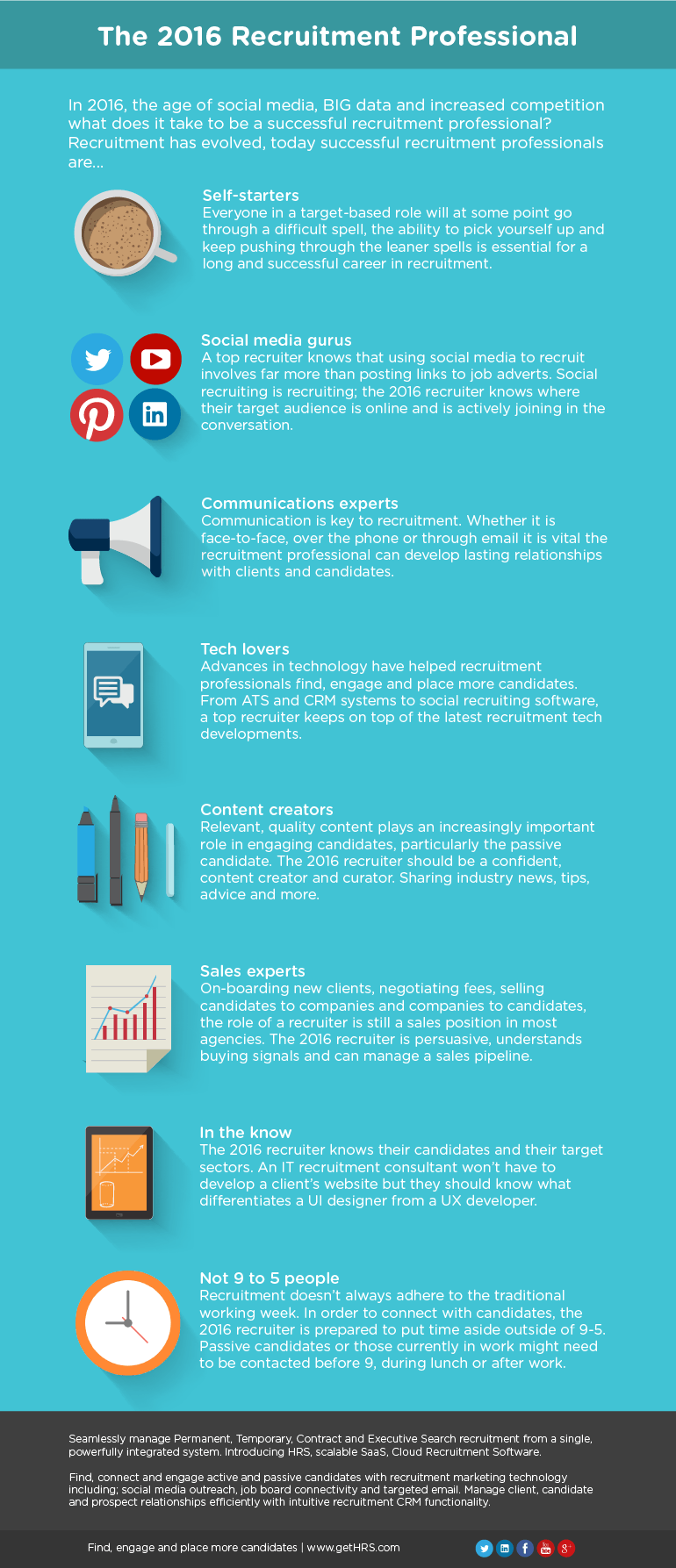
In 2016, what does it take to be a successful recruitment professional able to thrive as well as survive in this dog-eat-dog industry? Well, the folks at GetHRS have created an infographic listing the skills and traits you need if you want to stand out from the crowd:

?

Source: SocialTalent

An effective digital strategy by British government will benefit the UK and its citizens for decades to come. Richard Lee writes.

Just prior to the New Year, the UK government quietly posted a notification that it was “seeking ideas for the next phase of the digital revolution”.

From what I have seen in terms of those responses, they might have been better served by standing on a soapbox at Speakers Corner in Hype Park and asking passers by for their opinions, as their call to action has unleashed a torrent of ‘thought pieces’, opinions and rants from virtually every corner of the UK.

Over the past several years, I have followed with great interest all of the digital transformation programmes that central governments across the world have embraced in their efforts to bring ‘digital to the masses’, while improving government services and efficiencies.

Most of these have now evolved into ‘cults’, with every agenda seeker and crackpot out there opining the virtues of their ‘flavour of digital’ on social media and at every conference imaginable.

During this same time, we have seen ever-increasing budgets allocated to these programmes, high levels of management attrition, and dubious ROI results being promoted as ‘savings realised’.

But the single most glaring aspect that troubles me in virtually all of them is: what is the long-term strategy? It certainly can’t be just making better websites or training the entire population to hack code.

‘Digital’ as a term encompasses all disciplines in respect to embracing all that the web, data and analytics have to offer. There are core competencies that must be leveraged in an organisation’s strategy in order to be an enabler of the desired outcomes from it.

The UK (whether in or out of the EU in the future) must create a competitive strategy that makes it relevant on the world stage in order to capture inordinate levels of external investment and develop the greatest talent pool in all sectors, all at the expense of its peers.

This notion of differentiation is a much more business-like view of the needs of a country, but most have been evolving their thinking in this direction for quite some time now.

If the UK wants to punch above its weight in the world, it needs to make its core competencies the strongest and most sustainable, and difficult to duplicate or commoditise by countries motivated to do so.

A long-term competitive strategy for the UK should fully leverage all of its investments and know-how in digital to date – including capabilities, infrastructure and people – to create clear lines of differentiation in respect to other countries pursuing similar paths. Sustainability for this momentum should be built far into the future.

Here are four things the UK government needs to include in its digital strategy going forward, and a few it definitely doesn’t.

What’s needed?

1. Bank digital into long-term strategy

Use digital as a focal point to create sustainable sources of competitive advantage for the UK by baking it into every aspect of the long-term strategy of the country and its the goals. It shouldn’t just be a fashion statement or feel-good programme.

2. Develop digital leaders who are more than cheerleaders and partisan politicians

This includes in the civil service, Cabinet Office and charities, as well as MPs. Regardless of class or age, all citizens should be educated from the earliest age to be literal in digital, throughout their entire academic and trade schooling. And digital leaders must be promoted based on competency and acumen (merit), not beauty, charm or politics.

3. Create a national culture that embraces digital at every turn

‘Digital’ should not just amount to people consuming interesting content over broadband. It should be made an essential element of daily life in all sectors of government, commercial and non-profit.

4. Invest, invest, invest

The government should invest inordinately in education, leadership development, infrastructure and culture to create sustainable sources of competitive advantage in all things digital.

What’s not needed?

1. Superlatives and exemplars

Digital is an evolutionary transition from the analog world we have known for centuries. It is not disruptive, but can be transformational if executed with speed and precision. Hype is not of value in any strategy.

2. Grandiose predictions as to the impact of outcomes or capabilities

At best, digital is incremental in terms of benefits and sources of competitive advantage. It is the execution that is critical, not the idea itself. Benefits will manifest over the long term.

3. Exclusion of any sector from participation

Or realisation of the full benefits of the strategy and its outcomes. All boats must rise accordingly in this strategic journey.


Source:  Information Age