I caught up with an old contact recently and we were discussing how the IT landscape has changed over the last few years as more functions are becoming engaged at a business strategic level rather than the traditional order taker.  What I found very interesting was my contact’s view of certain functions being more successful at this than others. He highlighted that, in his opinion, Enterprise Architecture as a department is very much established and on “ the executive's radar” whilst Business Analysis has typically not reached this level.

This raises the question: what can BRM departments learn from other functions which will help them become more established at an executive level?

Comparing Enterprise Architecture and Business Analysis , the duties/ deliverables for both roles are, according to Wiki:


Enterprise Architect (EA)

  • Alignment of IT strategy and planning with company's business goals.
  • Optimisation of information management through an understanding of evolving business needs and technology capabilities.
  • Strategic responsibility for the company's IT systems.
  • Promotion of shared infrastructure and applications to reduce costs and improve information flow. Ensure that projects do not duplicate functionality or diverge from each other and business and IT strategies.
  • Work with solutions architect(s) to provide a consensus based enterprise solution that is scalable, adaptable and in synchronisation with ever changing business needs.
  • Risk Management of information and IT assets through appropriate standards and security policies.
  • Direct or indirect involvement in the development of policies, standards and guidelines that direct the selection, development, implementation and use of Information Technology within the enterprise.
  • Build employee knowledge and skills in specific areas of expertise.


Business Analyst

  • Business requirements, i.e. business plan, key performance indicator, project plan…
  • Functional requirements, i.e. data models, technical specifications, use case scenarios, work instructions, reports…
  • Non-functional requirements
  • As-is processes, e.g. data flow diagrams, flowcharts
  • To-be processes, e.g. data flow diagrams, flowcharts
  • Data models, i.e. data requirements expressed as a documented data model of some sort
  • Business case, a strategic plan containing shareholders' risk and return


I’ve highlighted in bold the elements I believe have links/commonality to the BRM role, which has led me to the below conclusions and further questions. 


1.BRMs can learn a significant amount from EAs for various reasons:

a. There is a significant commonality between the two positions.

b. EAs are now generally established at the business strategic level. How have they done this and what can BRMs learn from EAs to help them reach this level?

c. What tools (or elements of tools) are available to EAs that can also be utilised by BRMs to help them along this journey?

2. Where does the EA roles end and the BRM roles begin? Do the roles/functions need to consider merging?

     3. Business Analysis, whilst sharing less commonality, is an established function with established tools including              those within (high level) business requirements and business cases.  Such tools can help BRMs also become              more established and need to be utilised.  

     4. What other established functions can BRMs tap into?  Other business partnering functions? PMO?  Who else?                                         

There is a strong desire in the BRM community to become more established at the business strategic level and whilst specific tools and procedures are available to achieve this, we shouldn’t forget there is also a fountain of knowledge available to us via peers in different functions, some of whom have already successfully achieved what the BRM community is looking to accomplish.

‘Managed Services’ has become somewhat of a buzzword, with article headlines urging companies to move towards what they call the ‘modern model’. But underneath the entire buzz, for many of us, the question still remains– what are managed services and what are they good for? This is the question we at Certes will aim to answer clearly and in enough depth to give you a better grasp of how managed services work and the pros and cons for both clients and providers.

In a nutshell, a managed IT service is an information technology task provided by a third-party contractor for a client organisation. Managed services can be tailored to almost any business requirement within IT. Managed Services frequently comprise running applications, databases, data recovery and back-up, network management, storage, security, and monitoring. However, not all managed services are technology-based, despite that being the most widespread use of the term. At its most basic level, a managed service is an outsourced business need which may even cover things like marketing and transportation.

A managed IT service comes with a service-level agreement (SLA), which is the contract between the service provider and the customer. The SLA identifies what services the provider will supply and how successful delivery of services will be measured.

Within this model, the client owns or has direct oversight of their organisation or system. The managed services provider (MSP) is the service provider delivering the managed services. The client and the MSP enter into a contractual, service-level agreement that defines the performance and quality metrics of their relationship.

What are the benefits of Managed Services?


  • Enabling business agility and adaptation. Managed services are emerging as an invaluable strategic asset that aids enterprises in adapting more quickly to changes in the market. This is achieved by allowing quick access to new capabilities via cloud services, such software as a service (SaaS), platform as a service (PaaS) or infrastructure as a service (IaaS). In addition, access to data and analytics is enabling enterprises to better assess current and future business needs.


  • Optimising productivity and performance. While managed services open doors to accessing specific talent, cloud capabilities help to improve employee productivity and efficient use of resources. Cloud capabilities are also utilised to focus enterprise needs by requirements of each business unit and specific systems of engagement (e.g., sales, marketing, customer support).


  • Ensuring integrated, end-to-end “hybrid” IT service delivery and management. Companies also are using managed services as a way of receiving support across a hybrid of IT linking traditional delivery models and up-and-coming cloud-based options, which are far more automated.


Pros and Cons of Managed Services

Pros

  • Because the provider is responsible for the delivery and management of stakeholder expectations, the client business can fully focus on their core strategic initiatives
  • Providers can have more autonomy and benefit from a fairly disturbance-free supervision of the project.
  • Providers will be able to make long-term strategic investments that should indirectly benefit the client organization.
  • Providers are able to implement their best practices into the project, and therefore make key process improvements rather than having to fit into a rigid existing framework.
  • Knowledge retention becomes more streamlined and sustainable.

Cons

  •   Providers can be disinclined to take on additional management duties
  • There can be a culture incompatibility between the client and provider organisations which can lead to a lack of understanding or a breakdown of collaboration between the two, which in turn can have an impact on outputs and deliverables
  • In some situations, because they are external to the organisation, providers will not be able to understand all of the client organisation’s problems, pain points and worries. They may also struggle to fully grasp the scope of the project, which might result in significant delays and setbacks.
  • Where there are multiple managed service providers, with each managing a different part of the organisation’s IT requirements, it is not uncommon to find an approach of shifting blame, with providers being unwilling to take responsibility for disappointments and failures.
  • Despite process improvements bringing great benefits, a potential disadvantage of such improvements is a reduction in the number of people necessary to support the project. This is a drawback for the providers who may lose out on billing due to a reduced requirement of service.
  • The client may wish or need to re-allocate the contract to a new managed services provider, perhaps in part due to issues in performance or the SLA not being honoured. This is likely to become a significant challenge for the client, because the existing provider may become hostile or less co-operative.

On the whole, managed services are a great asset to any modern organisation, with opportunities to benefit in a multitude of ways. An MSP can lead to significant reductions in costs. Most providers will charge an upfront fee and then an ongoing fixed monthly fee, which provides clients with a set monthly expenditure, making financial planning much easier. Outsourcing managed services also allows business owners to reduce the cost of employees working in-house as well as the technology, tools, and other resources needed to handle the tasks.

Secondly, the managed service provider will bring the knowledge, expertise and experience in their service offering that will enable increased accuracy and decreased risk and liabilities, especially since they have to ensure compliance with government regulations and various industry standards.

Third, the MSP will have the tools, technology, and resources required to improve efficiencies by streamlining procedures and various processes. This can then lead to increased transparency and better understanding, which will then provide a foundation for stronger decision making based on factual, real-time statistics and information.

Content: Share This

We mentioned that the last few years have experienced many global companies being targeted and attacked, compromising thousands upon thousands of sensitive customer details. The latest casualty to undergo a data breach is the telecommunication company, TalkTalk.

On the 21st October, TalkTalk released a statement that they were a part of a cyber attack where details of millions of customers may be at risk. Information such as the names, addresses, dates of birth, email addresses, telephone numbers, TalkTalk account information and even credit card details and/or bank details were all at risk.

This is the third time that TalkTalk have been a target in a cyber attack.

After investigating this cyber attack, police have arrested four people in connection with the attacks, two of which were teenagers. A 15 year old boy from Northern Ireland and a 16 year old boy from West London 

This isn’t the first time that a child has been involved in hacking. Betsy Davies, a seven year old primary schooler managed to hack laptops connected to open Wi-Fi networks. This however was done in a controlled environment to replicate open Wi-Fi networks found on high streets. It took Betsy only 10 minutes and 54 seconds to not only learn how to set up a rouge access point – frequently used by attackers to activate what is known as a ‘man in the middle’ attack but to access information on laptop traffic.

What is incredible and scary is that an issue that can cripple companies and put the details of the public at risk is shaping up to be something a child can access. However, It is great to see that children are taking an interest in IT and bodes well for the future of the industry. If this interest increases and more children take an interest in IT, the skills shortage in the cyber security could diminish. Let's just hope that children use this interest for good.

In a recent blog from Certes, we talked about Generation Y also known as Millennials and how employers can recruit and retain them.

A report from Software Advice, a company that offers listings and reviews of the top recruiting software systems, continues this discussion with what Millennials really want. As software Advice explains “The “Greatest Generation” primarily sought stability, only changing jobs a few times in their lives. The “baby boomers” and “Generation X” became more restless, holding an average of about 11 jobs in a lifetime”. Millenials employment patterns however are different than that of the previous generations and can hold up to 20 different jobs. This goes with what we mentioned and that “Millenials will often move on if they don’t feel like they are being listened to, challenged or given enough responsibility”.

From a sample of 1355 Millennias, Software Advice came back with some interesting finds.


What Gen Y Really Wants in a Job

Salary and Benefits – Money is still an incentive but 34% Millennials are moving more towards ‘Salary and benefits’

Culture and Atmosphere – 31% of Millennials say they need to like where they work

Fulfillment and Satisfaction – 30% of Millennials say they need to enjoy what they do

Growth and Development – 25% of “Millennials say growth and development is important. Software Advice accredits this to Millenials …“are, by definition, on the younger side of the age spectrum: many cited a desire for “learning” or to gain more on-the-job “experience,” and noted they wanted to “advance [their] career.”

Software Advice concludes their findings with “What Gen Y really wants is to make a good living—but these young professionals also want to find happiness, fulfillment and opportunity in their work, and to build the foundation for a career that rewards in ways beyond the mere financial.”

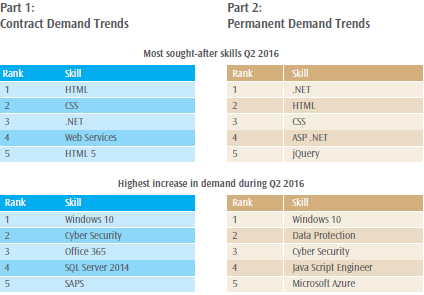
According to Certes 4Sight review, the demands for skills have changed slightly for both contract and permanent IT employment.

In Q1 contract and permanent employers were seeking Microsoft skills as their number one demand. In Q2 Microsoft skills have been removed from the contract and permanent and replaced with HTLM and .NET respectively.

For contract, the demand for Web Services and HTLM5 skills have increased and have pushed Oracle out of the top five demanded skills

For Permanent, jQuery has entered in the top five demanding skills list taking the place of Microsoft.

Surprising the skills with the highest demand increase is windows 10. This demand could be down to a couple of reasons such as companies using Microsoft’s latest operating system or that Windows 10 has now integrated the use of the Bash command-line shell that can enable users to Linux based command lines.

Though not as much of an increase in demand compared to Q1, Cyber Security is still seeing some increase in demand ranking 2nd for contract employment and 3rd in permanent.  Although Data protection can be seen as a form of Cyber Security, this skill has had an increase in demand in permanent employment.


Social media has mad a giant impact on recruiting and recruiters are using social media to gain insights into potential candidates.


Social Impressions Infographic

Source: Undercover Recruiter


A BA’s role will vary depending on each organisation or project, but understanding the nature of the business problem is an essential skill.

According to the latest issue of Analysts Anonymous a good BA will ask a lot of questions, work well as an individual and as part of the team, and really understand what a business’ requirements are through careful planning and evaluation. Failure to assess the business problem can mean BAs don’t deliver the required solutions on time and to a high standard.

Questioning and listening are fundamental to gaining this understanding and the BA must demonstrate the following qualities to succeed:

  • Genuineness – be interested in what is being said to establish a good relationship from the offset.
  • Respect – showing respect to the individual and their personal views is key to gaining their trust.
  • Understanding – a clear understanding of the subject matters being disclosed will assist in identifying the problems that are hindering the growth of a company.
  • Questions – using open questions will allow for more detail to be gained whilst closed questions will round off the debate. Putting the negative emphasis on yourself when you have not fully understood will provide an opportunity to ask more detailed questions.

More guides, tips and opinions about the BA function can be found in our regular publication Analysts Anonymous.

The enigma of Millennials is one that is in the forefront of every employers mind. Times are changing and companies will largely consist of this new generation in the years to come, with 75% of the workforce being made up of Millennials by 2025.

We have discussed what millennials really want in the workplace and briefly touched upon how managers can recruit and retain this up and coming breed of employees. So what else can employers do to ensure that millennials are kept happy and remain loyal?

Provide structure. Millennials were raised and are accustomed to structure; they expect this to be commonplace in the workplace. Employers should define clear and consistent job assessment criteria’s.

Provide leadership and guidance. Millennials prefer to follow leaders who are honest and treat them with respect. One of their strongest traits is that they welcome and expect regular, detailed feedback and to be praise for a good job. Millennials want know the ‘in’s and out’s’ of what is going on in the working environment. Employers should spend time coaching and guiding millennials which will keep millennials engaged in their work. Leadership and guidance will develop millennials enabling them to acquire new skills and abilities which they strive for.

Help millennials to grow. Working alongside providing leadership and guidance, managers need to really understand the personal and professional goals of millennials. Rotate assignments more frequently to give them a sense that they are moving toward something and gaining a variety of experiences. Challenge them to come up with new ways to streamline processes and to exercise creativity.

Millenials are team players. They are used to working in groups and teams, in contrast to the lone wolf of previous generations. They believe a team can accomplish more than working seperately. They are natural collaborators, particularly when the group’s purpose and goals are understood.

Listen to the millennial employee.  These young adults have ideas and opinions, and don't take kindly to having their thoughts ignored.  Millennials can provide you with a fresh pair of eyes and could come with useful idea’s that the other generations may have failed to see.

Take advantage of millennial technological literacy. Not all employees will be up to date with the latest communication trends, allow Millennials to share their technological knowledge to other generations in the workplace.

Provide a life-work balanced workplace. Millennials are looking for a good work/life balance. They work hard, but they are deterred by working unsociable hours. Millennials want to be able to work in the way that suits them best. Their extensive use of technology means that the line between work and home has become increasingly blurred, although many would prefer to work in an office than alone. In short millennials want flexibility in their jobs.

Provide a fun workplace. Millennials want to enjoy where they work. An environment that is comfortable and creative. This type of employee-focused environment may seem like an indulgence, but it is actually good for retention – and good for business because engaged employees are more productive.

Expect millennials to go: Like it or not, milleninials have a higher turnover rate than other generations, staying with a company for an average of 2 years. Many have made compromises in finding their first job, and this should be built into your plans. But if managers treat millennials well then they may have a higher chance of retaining them for years to come.

Health & Safety legislation has been in place since the early 70’s. It’s enforceable by law and it does exactly what it says on the tin – it mitigates risk and makes the workplace or classroom a safer place. Many people complain about it, but there is no doubt it is a good thing. Cyber security is the new Health & Safety, but with a few twists.  

For more information visit the National Cyber Skills Centre: Cyber Insights

Certes specialise in IT staffing for all sectors and industries. We are now working with the National Cyber Skills Centre in order to provide staffing to companies in need of cyber security. For cyber security jobs search on our site.

“Senator, we place ads,” will probably be one of those phrases that will forever remain a part of our memory of 2018. Whatever your opinion on the Facebook discussion may be, none of us can deny that the social network has utilised the latest in Artificial Intelligence to aid the advertising efforts of its paying clients. Most of us are Senator Cornyn when it comes to understanding the differences between AI, ML and DL. He knew what Facebook was but didn’t quite understand how it works.

We talk about the social, moral and political issues surrounding Artificial Intelligence, Machine Learning and Deep Learning, but often it’s not very clear what these terms mean, how they differ from one another and what might be everyday examples of each. These terms are often used interchangeably despite meaning somewhat different things. We can recognise AI and ML when we see it, for example in predictive texts that learn from our messages and add words to the phone dictionary. But if you were asked to define each concept and explain how it works and how it differs from the others, we would hazard a guess that such a task would be somewhat more complicated.

In light of this, we have put together this post to explain the difference between Artificial Intelligence, Machine Learning and Deep Learning, so that when it comes to these three concepts, none of us risk embarrassing ourselves similarly to the senator who didn’t understand how Facebook makes money.

Before we delve into explaining the differences, it is important to explain the most important building block of these technological advances – algorithms.

Computers know what to do with the code they are given. But before writing code, you need an algorithm.

At its most basic level, an algorithm is a sequential list of rules to follow that lead to solving a problem. Sequencing is crucial. Cooking is a helpful example of the importance of order in an algorithm. When you ask someone how to make steak, they don’t tend to give you the steps in random order or in a different order each time.

“Well, you put meat on a plate, then the plate on a hot stove, then place a pan on top of it and season the top of the pan.”

a man telling a woman the wrong order in which to make food

The order of things matters and that is exactly how an algorithm functions. The code is a recipe to be executed by a computer exactly in the order it is laid out.


Artificial Intelligence

Artificial Intelligence sounds like someone who took a 10 question “totally legit” test on BuzzFeed and got an IQ score of 250. Fake intelligence. You can’t trust it, no one has verified it.

But that’s not it. So why is it called artificial intelligence? What’s artificial about it?

There is much dispute over this, with some claiming that artificial should stand for ‘false’ because it’s not human, and others saying ‘artificial’ only because it is created by humans and didn’t originate from natural causes. The scientific community hasn’t firmly decided one or the other, and neither will we.

So what is AI then?

AI is the best umbrella term for explaining advanced computer intelligence.

It summarises the efforts to make computers think the way we think, to be able to simulate human cognitive thinking and decision-making, leading to human-like actions, and ultimately to be better and faster at problem-solving than we are.

Artificial intelligence (AI) makes it possible for machines to use experience for learning, adjust to new inputs and perform human-like tasks.

Artificial intelligence is generally divided into two types – narrow (or weak) AI and general AI, also known as AGI or strong AI. More recently a third type has been introduced – conscious AI.


  1. Narrow AI

Narrow AI is designed to perform one task at a time and to continue improving its execution. The goal is to find an automated solution to a problem or inconvenience or to simply improve something that already works, but can work better.

Currently, most of Artificial Intelligence is Narrow AI. Narrow AI tends to be software that is automating an activity typically performed by humans, and in the majority of the cases it exceeds or aims to exceed, human ability in efficiency and endurance.

Examples of narrow AI:

  • Self-driving cars that learn how to drive like Google and Uber cars, which as of now exist
  • Recognizing your face at your nearby bank office to help you with a more personal experience
  • We can ask our smartphones about the weather and expect accurate predictions.
  1. General AI

Some call it ‘The True AI’ because it is the next step towards more comprehensive machine intelligence. Rather than focusing on a single task, the goal is to teach the machine to comprehend and reason on a wide level just like a human would.

The goal is the machine’s ability to think generally, to be able to make decisions based on learning rather than previous training. It would have the ability to take training into consideration but then make a judgement on whether there is another, more appropriate course of action to be taken. Independent learning from experience, which is the way humans learn and reason, is the goal.

We are talking about creating an intelligence that is equivalent to that of a human being. That is a lofty task and one that we are still so far from accomplishing, but the geniuses of our time are hard at work to get closer and closer to this goal.

Over time, four tests of AGI have emerged as the primary definitions of the concept and the marker for judging whether something is generally intelligent.


  1. The Turing Test


The Turing test was first presented in Turing (1950). The main criteria for being recognised as an AGI is that the AI program needs to be able to win the the $100,000 Loebner Prize. This prize has been available for over 28 years and no one has won it yet. Overall there are two prizes that have never been won.·

  • $25,000 for the first program that judges cannot distinguish from a real human and which can convince judges that the human is the computer program.
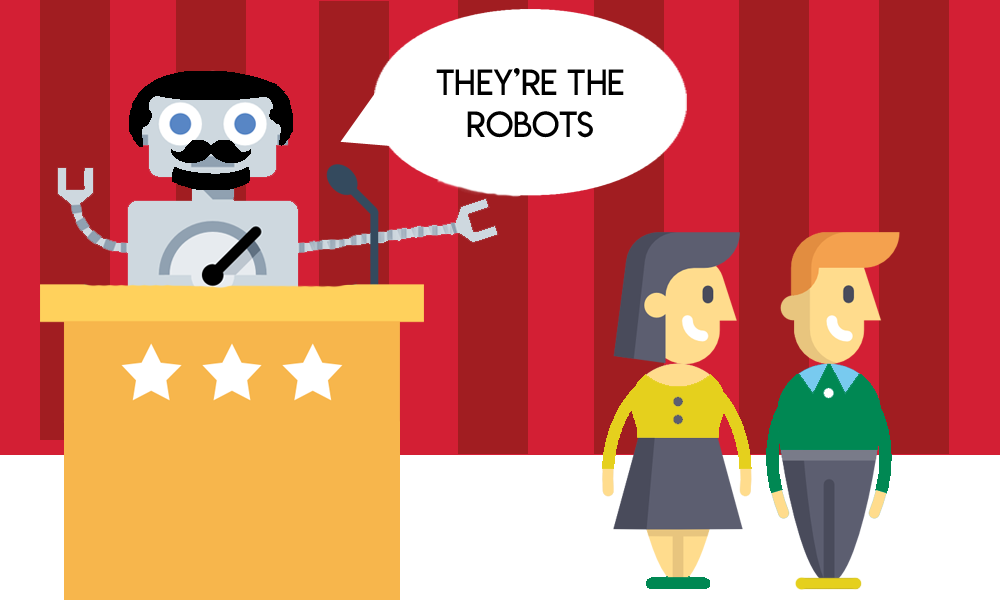
  • $100,000 for the first program that judges cannot distinguish from a real human in a Turing test that includes deciphering and understanding text, visual, and auditory input.

Once the $100,000 is won, the annual competition will no longer continue.


b.    The coffee test

In 2007, Apple co-founder Steve Wozniak came up with a different test for robots that cannot talk.

Wozniak claimed that there will never exist a robot that can go into a house, locate the kitchen and then the coffee machine, recognize the ingredients and equipment needed to make the hot drink, and finally understand how the machine works and how to use it. He argued that these cannot be programmed, only learned.

robot saying his latte art is good

  1. The Robot University Student Test

Instituted by Ben Goertzel, the Robot University Student Test requires the robot to complete a degree. In order to pass this test, the robot has to enrol onto a university course and go through the whole degree process just like a human would. It would need to study all the required subjects and pass the exams and tests required for obtaining the degree.


d.    The employment test

Computer scientist Nils John Nilsson suggested in 2005 an alternative test to the Turing, an employment test to show that “machines exhibiting true human-level intelligence should be able to do many of the things humans are able to do”, including human jobs.

The interesting part about AI and machine learning is that because it is focused on re-creating human intelligence in machines, it actually requires an increasing knowledge and understanding of humans. How and why we think, behave, make decisions, why we like and dislike things, how and why we change our minds and a whole myriad of other aspects of our cognitive makeup, that thousands of people have dedicated their careers to understanding. So as technology is evolving, the hamster in the wheel is our understanding of ourselves.

This raises the other million pound question – are AI and machine learning only as advanced as humans are? Or can their intelligence surpass us one day and lead to what many claim will be a world run by robots?


Machine Learning

At its core, machine learning is simply a way of achieving AI. Machine learning is an application of artificial intelligence (AI) that enables systems to learn and advance based on experience without being clearly programmed. Machine learning focuses on the development of computer programs that can access data and use it for their own learning.


There are 4 types of machine learning

  1. Supervised learning
  2. Unsupervised learning
  3. Semi-supervised learning
  4. Reinforced learning


1. Supervised learning

Supervised machine learning can take what it has learned in the past and apply that to new data using labelled examples to predict future patterns and events. It learns by explicit example.

Supervised learning requires that the algorithm’s possible outputs are already known and that the data used to train the algorithm is already labelled with correct answers. It’s like teaching a child that 2+2=4 or showing an image of a dog and teaching the child that it is called a dog. The approach to supervised machine learning is essentially the same – it is presented with all the information it needs to reach pre-determined conclusions. It learns how to reach the conclusion, just like a child would learn how to reach the total of ‘5’ and the few, pre-determined ways to get there, for example, 2+3 and 1+4. If you were to present 6+3 as a way to get to 5, that would be determined as incorrect. Errors would be found and adjusted.

The algorithm learns by comparing its actual output with correct outputs to find errors. It then modifies the model accordingly.

Supervised learning is commonly used in applications where historical data predicts likely future events. Using the previous example, if 6+3 is the most common erroneous way to get to 5, the machine can predict that when someone inputs 6+3, after the correct answer of 9, 5 would be the second most commonly expected result.  We can also consider an everyday example – it can foresee when credit card transactions are likely to be fraudulent or which insurance customer is more likely to put forward a claim.

Supervised learning is further divided into:

  1. Classification
  2. Regression


2. Unsupervised learning

Supervised learning tasks find patterns where we have a dataset of “right answers” to learn from. Unsupervised learning tasks find patterns where we don’t. This may be because the “right answers” are unobservable, or infeasible to obtain, or maybe for a given problem, there isn’t even a “right answer” per se.

Unsupervised learning is used against data without any historical labels. The system is not given a pre-determined set of outputs or correlations between inputs and outputs or a “correct answer.” The algorithm must figure out what it is seeing by itself, it has no storage of reference points. The goal is to explore the data and find some sort of patterns of structure.

Unsupervised learning works well when the data is transactional. For example, identifying pockets of customers with similar characteristics who can then be targeted in marketing campaigns.

Unsupervised machine learning is a more complex process and has been used far fewer times than supervised machine learning. But it’s exactly for this reason that there is so much buzz around the future of AI. Advances in unsupervised ML are seen as the future of AI because it moves away from narrow AI and closer to AGI (‘artificial general intelligence’ that we discussed a few paragraphs earlier). If you’ve ever heard someone talking about computers teaching themselves, this is essentially what they are referring to.

In unsupervised learning, neither a training data set nor a list of outcomes is provided. The AI enters the problem blind – with only its faultless logical operations to guide it. Imagine yourself as a person that has never heard of or seen any sport being played. You get taken to a football game and left to figure out what it is that you are observing. You can’t refer to your knowledge of other sports and try to draw up similarities and differences that will eventually boil down to an understanding of football. You have nothing but your cognitive ability. Unsupervised learning places the AI in an equivalent of this situation and leaves it to learn using only its on/off logic mechanisms that are used in all computer systems.
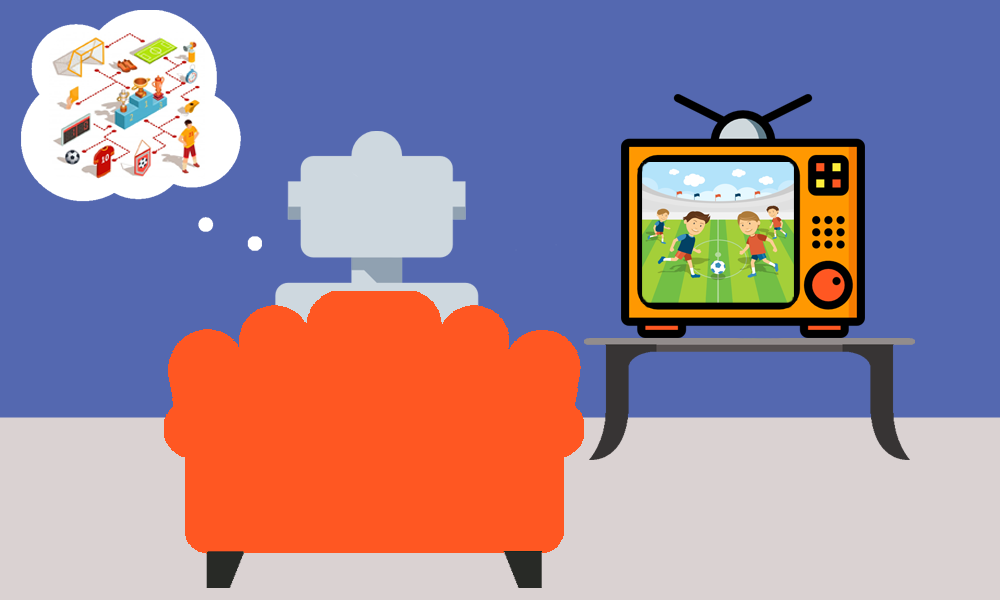
robot watching football on tv

3. Semi-supervised learning (SSL)

Semi-supervised learning falls somewhere in the middle of supervised and unsupervised learning. It is used because many problems that AI is used to solving require a balance of both approaches.

In many cases the reference data needed for solving the problem is available, but it is either incomplete or somehow inaccurate. This is when semi-supervised learning is summoned for help since it is able to access the available reference data and then use unsupervised learning techniques to do its best to fill the gaps.

Unlike supervised learning which uses labelled data and unsupervised which is given no labelled data at all, SSL uses both. More often than not the scales tip in favour of unlabelled data since it is cheaper and easier to acquire, leaving the volume of available labelled data in the minority. The AI learns from the labelled data to then make a judgement on the unlabelled data and find patterns, relationships and structures.

SSL is also useful in reducing human bias in the process. A fully labelled, supervised learning AI has been labelled by a human and thus poses the risk of results potentially being skewed due to improper labelling. With SSL, including a lot of unlabelled data in the training process often improves the precision of the end result while time and cost are reduced. It enables data scientists to access and use lots of unlabelled data without having to face the insurmountable task of assigning information and labels to each one.


4. Reinforcement learning

Reinforcement learning is a type of dynamic programming that trains algorithms using a system of reward and punishment.

A reinforcement learning algorithm, or agent, learns by interacting with its environment. It receives rewards by performing correctly and penalties for doing so incorrectly. Therefore, it learns without having to be directly taught by a human – it learns by seeking the greatest reward and minimising penalty. This learning is tied to a context because what may lead to maximum reward in one situation may be directly associated with a penalty in another.

This type of learning consists of three components: the agent (the AI learner/decision maker), the environment (everything the agent has interaction with) and actions (what the agent can do). The agent will reach the goal much faster by finding the best way to do it – and that is the goal – maximising the reward, minimising the penalty and figuring out the best way to do so.
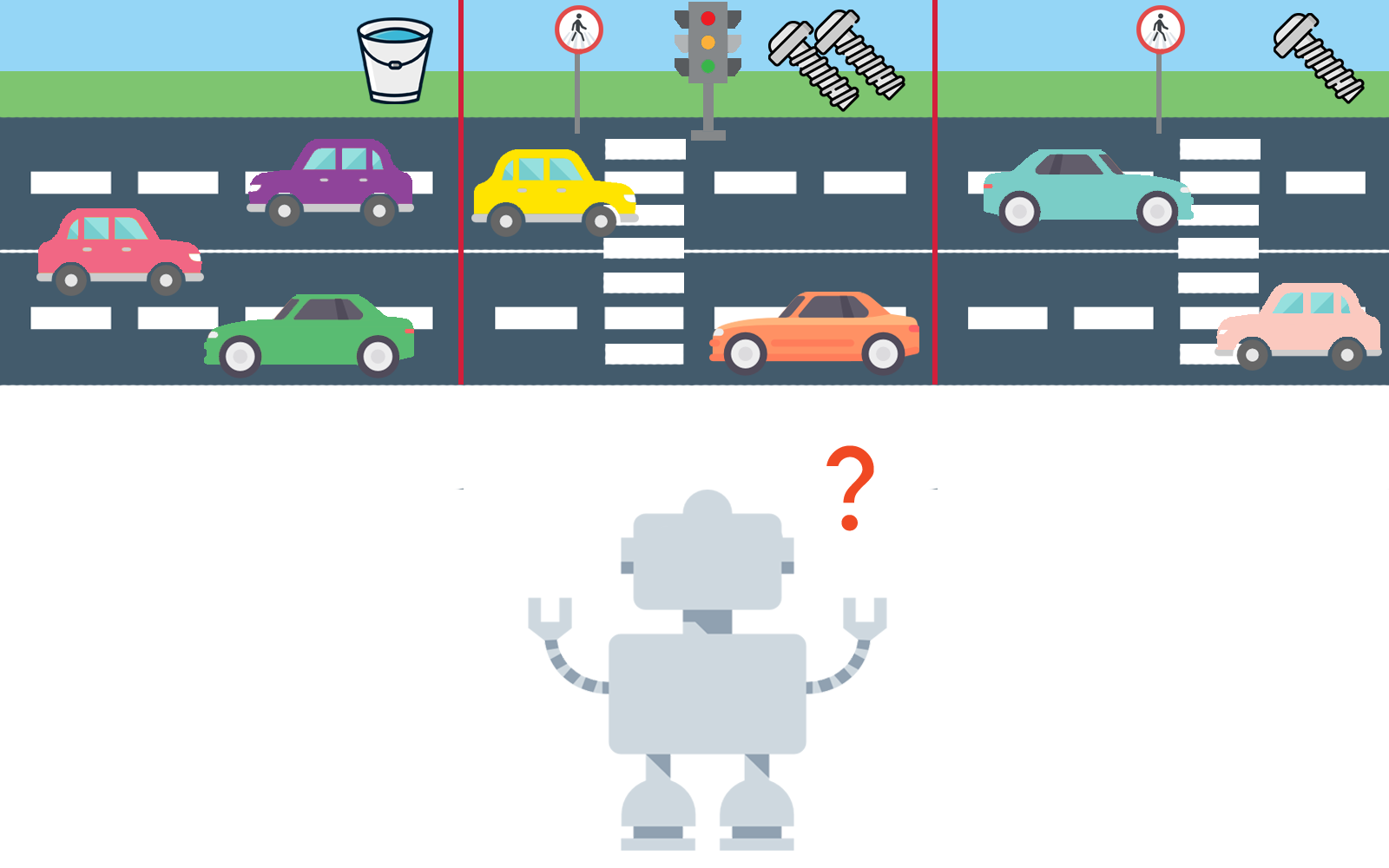
robot confused about where to cross the road

Machines and software agents learn to determine the perfect behaviour within a specific context, to maximise its performance and reward. Learning occurs via reward feedback which is known as the reinforcement signal. An everyday example of training pets to relieve themselves outside is a simple way to illustrate this. The goal is getting the pet into the habit of going outside rather than in the house. The training then involves rewards and punishments intended for the pet’s learning. It gets a treat for going outside or has its nose rubbed in its mess if it fails to do so.

Reinforcement learning tends to be used for gaming, robotics and navigation. The algorithm discovers which steps lead to the maximum rewards through a process of trial and error. When this is repeated, the problem is known as a Markov Decision Process.

Facebook’s News Feed is an example most of us will be able to understand. Facebook uses machine learning to personalise people’s feeds. If you frequently read or “like” a particular friend’s activity, the News Feed will begin to bring up more of that friend’s activity more often and nearer to the top. Should you stop interacting with this friend’s activity in the same way, the data set will be updated and the News Feed will consequently adjust.


Deep Learning

Deep learning is a specialized form of machine learning. Deep Learning is an artificial intelligence function that imitates the workings of the human brain in processing data and creating patterns for use in decision making. It is also known as Deep Neural Learning or Deep Neural Network.
Deep learning uses a hierarchical level of artificial neural networks for the machine learning process. These networks are built to resemble the way the human brain functions, with neuron nodes interconnected like a web. While traditional programs build linear networks, the hierarchical function of deep learning systems enables processing data in a nonlinear way.

A standard machine learning workflow starts with manually extracting selected features from images. These features are then used to create a model for categorising the selected objects. A deep learning workflow differs from this as relevant features are extracted automatically. In addition, deep learning performs “end-to-end learning” – it is given raw data and a task to perform, such as classification, and it learns how to do this by itself.

In machine learning, you manually choose features and a classifier to sort images. With deep learning, feature extraction and modelling steps are automatic.

However, because deep learning is still going through growing pains, there have been a number of concerns raised alongside the vast potential it holds, particularly around the ambition of achieving AGI through deep learning.

Gary Marcus, former head of AI at Uber, published a paper on deep learning which summarises some key concerns. Among the concerns he raised were:

  • DL is limited when it comes to open-ended reasoning based on real-world common sense and knowledge, meaning that machines wouldn’t be able to distinguish between “Tom promised Mary to stop” and “Tom promised to stop Mary”.
  • Deep learning is self-sufficient and is made up of correlations, rather than abstractions. Problems that deal largely with common sense reasoning are mostly outside of what deep learning can cope with.
  • Another problem often linked to deep learning is acquiring biases. If the training data set contains biases, the model will learn and consequently replicate those biases in its conclusions and predictions.

Despite the buzz surrounding deep learning, it is still a tremendous challenge. While great strides are being made in its progress, the journey of moving machine learning beyond pattern classification will be long and arduous.

So there you have it. We hope that now, should your next debate with friends or colleagues involve the differences between AI, ML and DL, you will stand proud. If not, we look forward to seeing Senator Cornyn-inspired memes about your blunder.

If you are looking for a new role where you can work within this field, or if you need fresh talent for your company or organisation – we would love to help.


[DISPLAY_ULTIMATE_SOCIAL_ICONS]


*certain icons in the images are created by the following FlatIcon authors: Vignesh Oviyan, Freepik, Dave Gandy, Vectors Market, Smashicons, Good Ware, Smartline, Iconnice, prettycons, Roundicons, Vector Pocket and Pixel perfect.