
What Does the Future Hold for the Public Sector? 

Artificial intelligence is rapidly transforming how organisations collect, analyse and use data. Across the UK public sector, AI promises to improve decision-making, automate administrative tasks, enhance citizen services and unlock greater value from existing datasets. However, these opportunities bring significant questions around data protection, governance and public trust. 

As government departments accelerate their digital transformation programmes, the challenge is no longer whether AI will become embedded in public services, but whether existing data protection frameworks can keep pace. 

Are Current Data Protection Regulations Fit for Purpose? 

The UK’s data protection landscape is built upon established legislation including the UK GDPR, the Data Protection Act 2018 and associated privacy regulations. These frameworks were designed to protect citizens while enabling organisations to use personal data responsibly. 

However, AI introduces complexities that traditional data governance models were not designed to address. Large language models, predictive analytics and autonomous AI agents require vast quantities of data, often sourced from multiple systems, organisations and jurisdictions. This raises important questions around: 

  • Lawful data processing at scale 
  • Data minimisation requirements 
  • Purpose limitation 
  • Transparency and explainability 
  • Ownership and accountability for AI-driven decisions 
  • Cross-border data transfers 

Recognising these challenges, the Government has launched consultations examining how data protection rules affect AI, international data transfers and the re-use of public sector information. The UK Government is also seeking evidence on how existing regulations interact with AI and other data-intensive technologies, with a focus on ensuring the UK’s regulatory framework remains fit for an increasingly AI-driven economy.

The key question is whether regulation should adapt to AI, or whether AI solutions should be designed to operate within existing regulatory boundaries. 

The likely reality is a combination of both. 

The Data Use and Access Act 2025 

The introduction of the Data Use and Access Act 2025 marks an important development in this debate. According to the Information Commissioner’s Office, the Act updates aspects of the UK’s digital information and data protection framework, amending rather than replacing the UK GDPR, the Data Protection Act 2018 and the Privacy and Electronic Communications Regulations. Its purpose is to make data protection law easier for organisations to apply, support innovation and economic growth, and continue protecting people’s rights.

For AI adoption in the public sector, this is significant. The Act creates clearer routes for responsible data use, including provisions around research, automated decision-making, cookies and data protection complaints. It also reflects a shift towards enabling organisations to innovate while maintaining safeguards such as transparency, accountability and appropriate protection for individuals. 

However, the Act should not be interpreted as a relaxation of responsibility. Instead, it places greater emphasis on organisations understanding how they use data, documenting decisions, applying safeguards and being able to demonstrate that AI-enabled processing remains fair, lawful and transparent. In practice, this means public sector bodies will need to align innovation with strong governance, especially where AI is used to support automated decisions, large-scale analytics or joined-up services across departments. 


Will AI Speed Up Government Data Sharing? 

One of the long-standing goals of public sector digital transformation has been to enable secure and effective data sharing between departments. 

AI could become a significant enabler of this objective. 

By intelligently analysing and categorising data, AI can improve discoverability, identify duplicate records, automate data cleansing and support interoperability between legacy systems. These capabilities could help accelerate government initiatives aimed at creating more connected public services. 

At the same time, AI introduces additional complexities. 

As data flows across departments, agencies and suppliers, organisations must maintain visibility of: 

  • Where data originates 
  • How it is being processed 
  • Who has access to it 
  • Whether data usage remains compliant with agreed purposes 
  • How AI-generated outputs are validated and governed 

Without robust governance frameworks, the increased movement of data could create greater exposure to security, privacy and compliance risks. 

In many respects, AI may actually force organisations to improve their data protection maturity before they can fully realise its benefits. 


AI Security Risks Cannot Be Ignored 

Perhaps the greatest concern for public sector leaders is that AI expands the attack surface. 

As organisations introduce AI models into critical services, they must also consider: 

  • Model poisoning attacks 
  • Data leakage 
  • Unauthorised access to training datasets 
  • Supply chain vulnerabilities 
  • Hallucinated outputs influencing decision-making 
  • Insider misuse of AI tools 

Government’s broader approach to AI adoption reflects this balance between innovation and security. Recent initiatives such as the Rapid AI Delivery (RAID) Taskforce demonstrate a growing focus on accelerating AI deployment while maintaining operational oversight and governance. The initiative was created to accelerate the adoption of AI and frontier technologies while addressing real-world operational challenges through careful evaluation and implementation.

The lesson for public sector organisations is clear: successful AI adoption requires security, governance and compliance to be embedded from the outset, not bolted on afterwards. 


Predicting the Future of Data Protection 

The future of data protection is unlikely to be defined by more regulation alone. Instead, we are likely to see a greater emphasis on intelligent governance, where technology itself helps organisations manage compliance. 

Several trends are beginning to emerge: 

Privacy-Enhancing Technologies (PETs) 

Technologies such as synthetic data, anonymisation and privacy-preserving analytics are likely to play an increasing role in enabling data sharing while protecting individual privacy. Government consultations have already identified these technologies as important areas for future development.

AI-Assisted Compliance 

AI may become a powerful tool for helping organisations manage data protection obligations by automatically monitoring data usage, identifying risks and supporting audit requirements. 

Greater Transparency Requirements 

As AI becomes more influential in public service delivery, citizens will expect greater visibility into how their data is being used and how decisions are made. 

Stronger Cross-Government Governance Frameworks 

The demand for joined-up public services will likely lead to more standardised approaches to data governance, interoperability and security across departments. 

Trust as a Strategic Asset 

Ultimately, public trust will become the defining factor in AI adoption. The organisations that can demonstrate responsible AI practices, transparency and robust data protection will be best positioned to realise AI’s full potential. 

  

How Certes Helps Public Sector Organisations Navigate AI Safely 

The challenge facing public sector organisations is not simply adopting AI. It is adopting AI responsibly, securely and in a way that delivers measurable outcomes. 

At Certes IT Service Solutions, we help organisations bridge the gap between innovation and governance. 

Whether you are developing an AI strategy, modernising legacy systems, improving data governance or strengthening cyber security controls, we provide the expertise needed to deliver transformation with confidence. 

As AI continues to reshape the public sector, the organisations that succeed will be those that balance innovation with trust, agility with governance, and opportunity with accountability.


Strengthening our commitment to delivering secure, mission-critical digital transformation services across the UK public sector. 

Certes IT Service Solutions is proud to announce that we have been awarded a place on the G-Cloud 15 Framework, reinforcing our position as a trusted partner for government departments, public sector bodies, and organisations operating within highly secure environments. 

“For Certes, previous successes through G-Cloud have demonstrated the framework’s ability to connect public sector organisations with trusted SME delivery partners. A notable example is our award for the Pegasus International Programme Management Function, which highlighted how SMEs can successfully deliver complex, mission-critical outcomes through this route to market. 

Being awarded a place on G-Cloud 15 is another important milestone for Certes. It strengthens our ability to support government departments with secure digital transformation, cloud services, cyber security, and delivery expertise, helping them achieve their objectives with confidence and pace.” – Luke Claydon, Managing Director 

As an independent IT consultancy with extensive experience across defence, national security, central government, and the wider public sector, Certes delivers secure-by-design digital transformation programmes where resilience, security, and operational excellence are critical requirements.  

Our inclusion on G-Cloud 15 enables public sector organisations to access Certes’ expertise across: 

  • Digital transformation and change delivery 
  • Cloud strategy, migration, and optimisation 
  • Digital engineering services 
  • Cyber security and information assurance 
  • Programme and project delivery 
  • Software development and application modernisation 
  • Infrastructure and cloud support services 


We look forward to helping government accelerate digital transformation, embrace cloud technologies, and deliver secure, innovative services that create lasting value. 

For more information about Certes IT Service Solutions and our G-Cloud 15 service offerings, please contact our team. 

An interview with Mark Whittington, Project Manager at Certes IT, by Louise Shade, Marketing Manager.


Mark Whittington
Project Manager

After 28 years in the military, Mark Whittington’s move into a project management role within Defence was less a clean break and more a natural evolution. The terminology changed, the environment changed, and the commercial world took some getting used to, but the core skills were already there: leading people, managing budgets, solving problems and delivering outcomes under pressure. In fact, transitioning to the responsibilities of a Project Manager in Defence is something many ex-military professionals experience.

“Everyone was saying everybody that leaves the military is almost like a natural project manager,” Mark explains. “The roles and responsibilities that you have as a PM naturally align to how you deliver things within the army. They’re called different things, but the processes are the same.”

For Mark, the attraction was also personal. After two decades in specialist welfare roles, he wanted a fresh challenge, one that still drew on his strengths. A long-standing interest in technology, combined with experience running IT projects in his final military role, helped him see where he could add value: bridging the gap between technical teams and end users.


From military delivery to project management

One of Mark’s biggest lessons is that project management is rarely about applying a textbook methodology perfectly. In fact, managing projects as a Project Manager in Defence environments often means adapting to what each situation demands. In practice, he has found that successful delivery often means taking a hybrid approach; combining structure, governance and flexibility depending on the challenge in front of you.

“The only methodology that I would say I have applied for project management is a hybrid approach,” he says. “It’s a little bit like going around Tesco’s and doing shopping for a recipe because you need a little bit of this and a little bit of that.”

That adaptability, Mark believes, is especially important in secure and complex environments where teams are often geographically dispersed, priorities shift, and no single framework fits every situation. Methodologies still matter. They provide the handrails for governance, risk, budget control and decision-making, but delivery also depends on judgement.


Building trust starts with authenticity

When asked how to build trust with stakeholders in a highly regulated environment, Mark’s answer is immediate: “Be authentic. You have to be authentic, and if you don’t know, you have to own it.”

He is clear that a project manager does not need to be the most technical person in the room. Their role is to coordinate the people who are. Within the defence sector, Mark describes the role as similar to a conductor of an orchestra, orchestrating success as Project Manager in Defence by bringing together different specialists so that, collectively, they can deliver something that works.

That trust is built by getting alongside people, understanding what they do and asking what they need. “What do you need from me to make your job better?” is a question Mark has carried into his work with technical teams.

It is also about protecting the team. Mark believes people do their best work when they feel safe, valued and heard. A leadership principle he developed in the military and still applies today. “If they know that you’ve got their backs, they will hopefully work harder for you because they feel valued.”


Listen to the experts

Technical experts have had a major influence on the way Mark manages projects. His advice is simple: listen to them. They are the subject matter experts, and a PM who ignores their advice risks setting unrealistic expectations and losing the confidence of the team. Thus, listening is a critical part of being a Project Manager in Defence roles.

“Technical people are there for a reason,” Mark says. “I’m just the conductor. I can’t go in and connect a network or activate switches — that’s what they do.”

This also means being realistic with stakeholders. Project managers sit between the team doing the work and the people expecting the outcome. Overpromising, Mark warns, creates pressure in the wrong place. “Don’t write a cheque you can’t cash to a stakeholder,” he says.


The best project teams believe in the journey

For Mark, the strongest project teams are the ones that understand the purpose of what they are delivering. Bringing people together from different departments, organisations and backgrounds is rarely seamless. Teams need time to form, challenge, settle and find their rhythm.


That process requires empathy and awareness. People work differently, communicate differently and respond to pressure differently. A good PM pays attention to those differences and creates the conditions for people to contribute effectively. In Defence, a Project Manager must be especially attuned to these complexities.

“It’s about taking people on the journey,” Mark says. “Understanding the need, believing in that need, believing in the plan — and then delivering it.”


The future of project management in secure environments

Looking ahead, Mark sees artificial intelligence as both an opportunity and a challenge. AI may be able to support planning, risk logs, budgets and administrative project management tasks, but he does not believe it can replace the human side of the role.

“AI will be very good at giving you a delivery plan, but it will not be able to coordinate a team. It will not be able to do the people-facing stuff.”

For Mark, the future depends on balance. AI can enhance delivery, but project management still relies on relationships, judgement, governance and trust. In secure environments, where risk and accountability matter, the human role of the Project Manager in Defence will remain essential.


Final reflections

Mark’s project management philosophy is grounded in experience: be authentic, listen properly, protect your team, manage risk openly and never stop learning. His military background gave him discipline, resilience and a delivery mindset, but his journey as a project manager has also taught him the importance of humility, curiosity and people-first leadership. Ultimately, succeeding as a Project Manager in Defence requires both technical and interpersonal skills.

“You can move mountains if you can get the team in the right place,” he says. And perhaps that is the clearest lesson of all: successful project management is not just about plans, processes or frameworks. It is about people. Bringing them together, giving them confidence and helping them deliver something that matters.


Certes IT and Tempo are proud to announce their sponsorship of RAF Netball, supported through the RAF Central Fund. The partnership backs a vibrant and inclusive sporting community that brings together the RAF community and reflects the values both businesses champion every day across the defence sector: commitment, resilience, teamwork and the power of working together.

With deep experience supporting defence organisations, we understand that strong teams are at the heart of every successful mission. RAF Netball demonstrates that same spirit on and off the court, creating opportunities for players, coaches and umpires to develop their skills, build confidence and contribute to a supportive network. This sponsorship celebrates shared purpose, performance and the collective energy that helps individuals and teams achieve their full potential.

The RAF Central Fund works to safeguard the health and wellbeing of serving RAF personnel by enabling access to sport and physical activity at every level. Its support helps ensure personnel can benefit from facilities, equipment, training and development opportunities, whether they are competing, learning, coaching or simply taking part for enjoyment, fitness and camaraderie.

Louise Shade, Marketing Manager at Certes IT, said: “This sponsorship was a no-brainer for us because of the values we share. We are incredibly proud to support RAF Netball and excited to get behind such an inspiring team. Their commitment, teamwork and determination reflect everything we believe makes organisations successful, both on and off the court.”

As proud advocates of the RAF Central Fund, Certes IT and Tempo are committed to helping ensure that everyone within the RAF, regardless of role, rank, physical ability or competing level, can access the sporting opportunities they need. Through this support, the Fund helps protect physical health, strengthen mental wellbeing and promote the sense of community that is so important across RAF life.

For Certes IT and Tempo, the sponsorship is more than a logo on a kit. It is a meaningful way to recognise the dedication of RAF personnel and to support a sport that encourages leadership, discipline, inclusion and personal growth. By standing behind RAF Netball, both organisations hope to help raise awareness of the role sport plays in building stronger, healthier and more connected teams.

We wish all the RAF Netball teams every success in the upcoming season.

Many people live by the maxim that if you fail to prepare, then you are preparing to fail. This is especially important during an IT job interview. As well as your standard set of interview questions, IT interviews will contain many specialist questions. Employers may be interested in questioning you on your skills, qualifications and coding languages.

To avoid being thrown off track, preparing possible answers can be really beneficial to your interview success. See below for some of the questions you can expect during an IT job interview.

About You

Firstly, expect general questions about you so the interviewer can get to know each candidate. For IT job interviews, this may also include questions on your technical skills and experience. This will help employers build an idea of you as both a person and employee.

You may be asked a series of questions including:

  • Why is this job position of interest to you?
  • What qualifications do you currently hold?
  • Which programming languages can you confidently work with?
  • What experience do you hold in using automated-build tools or processes?
  • What experience do you have in source control tools?
  • How do you keep up to date within this industry?
  • What were your responsibilities during your most recent project?
  • How would you score your time management skills with meeting deadlines?
  • Provide an example of a time when you were able to improve an original design from a client.

You could also be asked problem solving questions to test your knowledge, skills and professionalism. This may concern faulty code, spreadsheets and data bases, working with clients, and IT challenges in your previous projects.

Industry Knowledge

Next, employers will check that you have completed your research. Asking you questions on the job and company will help them to see how you will fit with their business.

You can expect to be asked a selection of the following questions:

  • Which skills of yours make you qualified for this job position?
  • If hired, what challenges would you expect from this role?
  • Who do you consider as our biggest competitors in this industry?
  • Following the job description, what do you expect your daily tasks to be?
  • How important is it to you to develop professional relationships with business users?
  • How would you describe your production deployment process?

A number of these questions could easily catch you out if you are not prepared. Therefore, we strongly advise thorough research into the job vacancy, company, industry and even their competitors. After all, in-depth research can help you to plan more original answers better suited to you.

Technical Ability

The following questions are all designed to test you on your skills and knowledge as an IT professional. Your interviewer will be determining your compatibility for the job role and company based on your answers. Therefore, it will be especially useful if you also prepare examples of past work to link to your answers. This will demonstrate experience, understanding and great potential.

  • How do you guarantee quality in your deliverables?
  • What experience do you have with Eclipse and Visual Studio?
  • What percentage of your working hours do you spend on unit testing?
  • Are you able to define what a transaction log is and how they should be used?
  • What is the term “honey pot” used for in network security?
  • Can you compare the similarities and differences between SOAP and REST web services?
  • With the original code you develop, how do you reuse and how much are you able to reuse?
  • What would you consider to be the most essential metrics for database performance and how do you monitor them?

Questions for Your Interviewer

Showing interest by preparing questions to ask can make a great impression on employers. Therefore, preparing questions for your interviewer is also key. Possible questions you could ask are:

  • What is the company’s greatest achievement to date?
  • What size is your IT team currently?
  • What are your biggest challenges as an IT company?
  • What development process do you have in place?

Applying for IT Jobs

As recruitment specialists, the Certes team are the match makers of the IT industry, pairing motivated applicants with compatible employers. To browse job vacancies in your area and secure an IT job interview, click here.

Balancing work and life are important for all employees but it is a difficult task for many. If not balanced correctly it could lead to employees becoming dissatisfied, unmotivated in their role and other negative impacts on life can occur such as lack of exercise, increased stress levels,  little social lives, psychological and physical health problems. A survey from Managers.org.uk focuses on the working hours of managers goes into detail about “Managers’ working hours in a digital era”.

According to the survey, managers are working extra hours and this trend has continued to rise since 2012.

“Managers’ contracted working hours have risen by one hour daily compared to 2012, which is equivalent to an additional 29 days extra each year. That’s more than the typical annual leave entitlement. Overall, 92% of managers work longer than their contracted hours. This pattern has resulted in a third of managers feeling ‘overloaded’ and a perception that long working hours are something they have ‘no choice’ about.”

A majority of managers are working between 41 to 48 hours (38%) with 23% of managers working beyond that, between 49 to 59 hours.

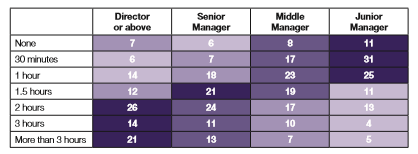
Depending on the seniority of the manager, the extra hours worked changes. Junior managers will tend to work an extra 30 minutes over contracted hours while Directors and above will work an extra 2 hours over contracted hours.

Despite the extra hours worked, under half (42%) of the managers surveyed do not feel overburdened with their workload. However, a third (33%) of managers feel that they are overloaded with work.

What is surprising is that while 63% feel that they have no choice to work the extra hours to meet deadlines, 54% work the extra hours by choice.

Being in a digital era and technology working alongside us in our daily work tasks, we were led to believe that work would be more efficient and our work lives would be made easier. However, technology has enabled an ‘always connected’ environment when away from our place of work and has also influenced the working hours.

Staying connected has also affected managers ability to maintain their work-life balance as being constantly connected makes it difficult for them to ‘switch off’ and leave work at work.

“61% of managers say that technology has made it difficult to switch off from work. Around one in five managers say they now check their email all the time outside of working hours; over half (54%) check frequently. This is particularly common among those in senior management positions.  Whilst not perceived unfavourably by all managers, constant email accessibility and digital connectivity mean longer working hours for some.”

?

Though technology is not the root of increase work hours, the ability to access work life while at home is a contributor.

The survey does not specify the industries that the managers are working within but IT managers and those working within the IT industry have to ability to work remotely. Employees within the IT sector have the power to access a multitude of areas without having to physically be in a specific location and this also opens the doors to working extra hours a to rectify problems or to meet deadlines.

Source: Managers.org.uk

Employers have to go through a sea of candidates before they find the right person for their position. With all their experience they have developed a keen sixth sense to see the underlining truths in what candidates say whilst in an interview. Cliched answers are boring to hear and the legitimacy of your answer may be up for debate.


To avoid falling victim into these interview fails, be truthful and informative. Instead of saying “I am a hard worker” give an example of your hard work and what the outcomes were. Avoid using useless jargon when a description is a better route. Although experience is what employers are generally after, if you can show a genuine desire to be a part of their team and you are likeable, employers will tend to work with you in order to fill the gaps.

We have seen what consultants look for in candidates, but this is a two way street. Candidates expect many things from the agencies that they interact with. Here, candidates who have used agencies share what they look for in an agency. Certes have asked  people who have dealt with agencies to find out thier views and what they look for.


“The most important thing that I look for in an agency is the ability to provide me with regular work that suits my needs i.e. workplaces within reasonable commuting distance, that treat employees and agency workers well. The agency should provide access to both long and short term roles and provide career professional development opportunities so that I am able to continue to enhance my skills while working for them. Agency recruitment staff should be friendly and have good interpersonal skills that make it clear that they are focused on finding you the right job opportunities. Agencies should contact you regularly with job opportunities that may be of interest to you based on their knowledge of your needs and requirements”.

Anonymous, Science Teacher

“As a job seeker and speaking with numerous agencies, the agencies that I return to are the ones that actually make an effort to contact me personally with new opportunities that match my skills. Multiple time agencies have notified me about openings that are not what I am looking for and that makes me feel that they are not interested in my needs and are only trying to fill jobs. An agency that takes time to find out what my ideal job is and informs me of any jobs available that fit what I want is what I look for in an agency”.

Andrew Robinson

“An agencies main job is to place people in jobs. I feel that this help should extend further, such as advice. Problems that I and other people may have come across are CV’s that are not up to scratch. Agencies should recommend changes to CV’s that would help improve chances of being selected for vacancies I have applied for. I know Agencies go through hundreds of CV’s a week, they are the best person to go for advice and tips to improve a job seekers CV”.

Kalvin Higgins, Alloy Refurb Specialist

“I work within IT and as such I possess many technical skills. The agencies that I go to need to have knowledge of these skills, if they don’t I have no faith that they will find jobs catered to me. As well as industry knowledge, agencies should keep me up-to-date on the progress of my application. There’s nothing more frustrating to me when dealing with agencies than being informed of a job that they think I would be perfect for and that I have applied to, to not hear anything back. A phone call or an email to let me know if I have been considered by the employer with feedback would help. This would give me information on what employers are looking for and would also give me a chance to see the areas that I may need to improve on in both my skills and CV”.

Imran Ebrahim, IT Manager


“Having the option to do an interview over the phone is something that I look for in an agency. Some agencies that I have used have asked me to come into their offices for an interview. I do not have a problem with making the journey but when the agencies are located in different regions of the UK it can be difficult to make the journey, for instance, travelling to Manchester from the West Midlands. Agencies should be aware of my location to where there office is so we can either arrange a mutual meeting location or we can arrange a time where we can discuss my background and what I am looking for over the phone.”

Anonymous, Marketing Executive

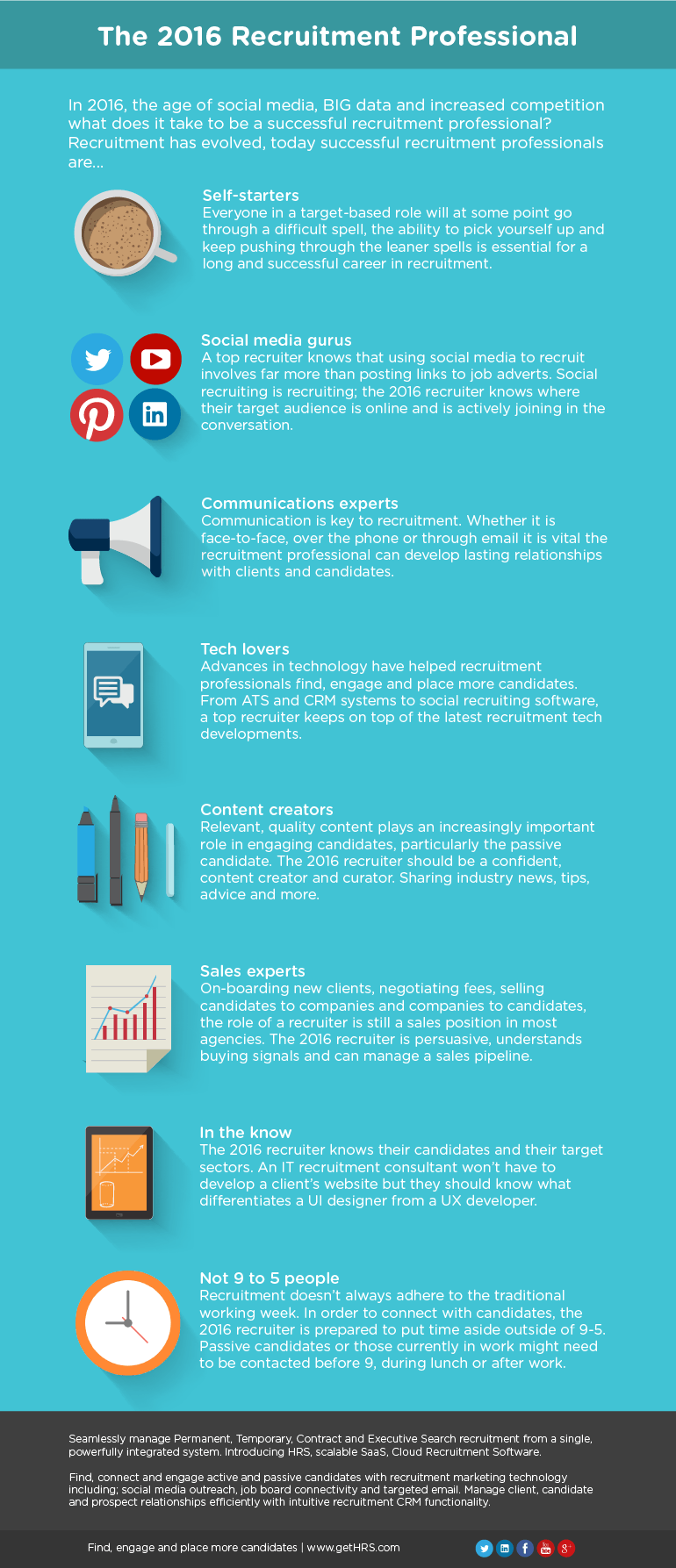
In 2016, what does it take to be a successful recruitment professional able to thrive as well as survive in this dog-eat-dog industry? Well, the folks at GetHRS have created an infographic listing the skills and traits you need if you want to stand out from the crowd:

?

Source: SocialTalent

It’s good news for job seekers. The job market is improving and with that people who are looking for vacancies now have more options.

The improved job market seems to be reaping benefits for jobs seekers and it turns out that it is becoming easier to find a job. According to research from Jobvite, 65% of job seekers asked are finding it easier to find employment compared to 39% from 2012, that’s an increase of 57%.

The results above shows job seekers who say it is harder to find jobs

Due to the better nature of finding employment, does this mean that job hopping will also increase? In a word, No. Let’s look into the IT sector. Jobvite explains that 53% of Software/Tech employees are satisfied with their current position; however they are open to new opportunities. This shows that even though it is easier to find a new job employees will remain where they are.

So who are the most likely to leave their current role?

According to the Jobvite’s research, the highly sort after  millennials are twice as likely to leave a job after just three years compared to previous generations. Surprisingly the IT sector shows the most job change frequency with 50% in this sector switching jobs every 1 to 5 years.

What is evident is those aged between 18 and 29 – Millennials, see their current position as an entry level post which they are using as a “stepping stone”. Millennials are in need of experience and will gain the experience in what they want to do, where they can until they acquire the skills needed for their dream job.

So far we have seen that it is easier to find new employment than it was a mere three years ago and the generation that are more likely to look for a new job are millennials. Millennials are adept with technology than previous generations and 47% are using mobile technology to search for their new role. It is also pointed out that job seekers and employees will spend some time searching for jobs on mobile with a majority of job seekers spending up to ten minutes. The ease of mobile job hunting allows for applying for jobs anywhere. Funnily enough most mobile job hunting is done in bed with searching while commuting is a close second.


Job seekers are  also using social media more to aid them with their job searching.  It is shown that millennials in the IT sector prefer using Twitter than Facebook and LinkedIn.


Is there a coalition between the improved job market and the use of social media? Yes, but its is down to the times that we live in. Technology that simplifies tasks are being used for nearly everything including job seeking. Millennials are accounting for a large segement of the workforce and these are the workforce that have knowledge and use social media the most.

For more information on the Jobvite survey, visit here


If your looking for you next IT role using social media feel free to connect with use on LinkedIn, Facebook, Twitter and Google+. You can also go to www.certes.co.uk to search for more IT job vacancies.